
Exciting presentations, panel discussions and plenty of opportunity for exchange – this was what the SID 2026 conference "Safer internet – growing up in the digital world" organised by the Austrian Safer Internet Centre had to offer, focusing on the everyday online lives of children and young people. Around 220 visitors attended the sold-out event, which took place in Vienna on 12 February 2026.

Safer internet – growing up in the digital world
The conference addressed key questions such as the challenges children and young people face on the internet and how to promote responsible use of digital media. The focus was on AI and its impact on young people's lives.
In addition to input from media experts, young people themselves contributed their perspectives and played a key role in shaping the symposium. In moderated table groups, they invited the audience to share their experiences and provided practical tips on topics such as artificial intelligence, love scams, cybergrooming and data protection. This gave guests a diverse and authentic insight into the digital world of young people.
Artificial intelligence as a central topic
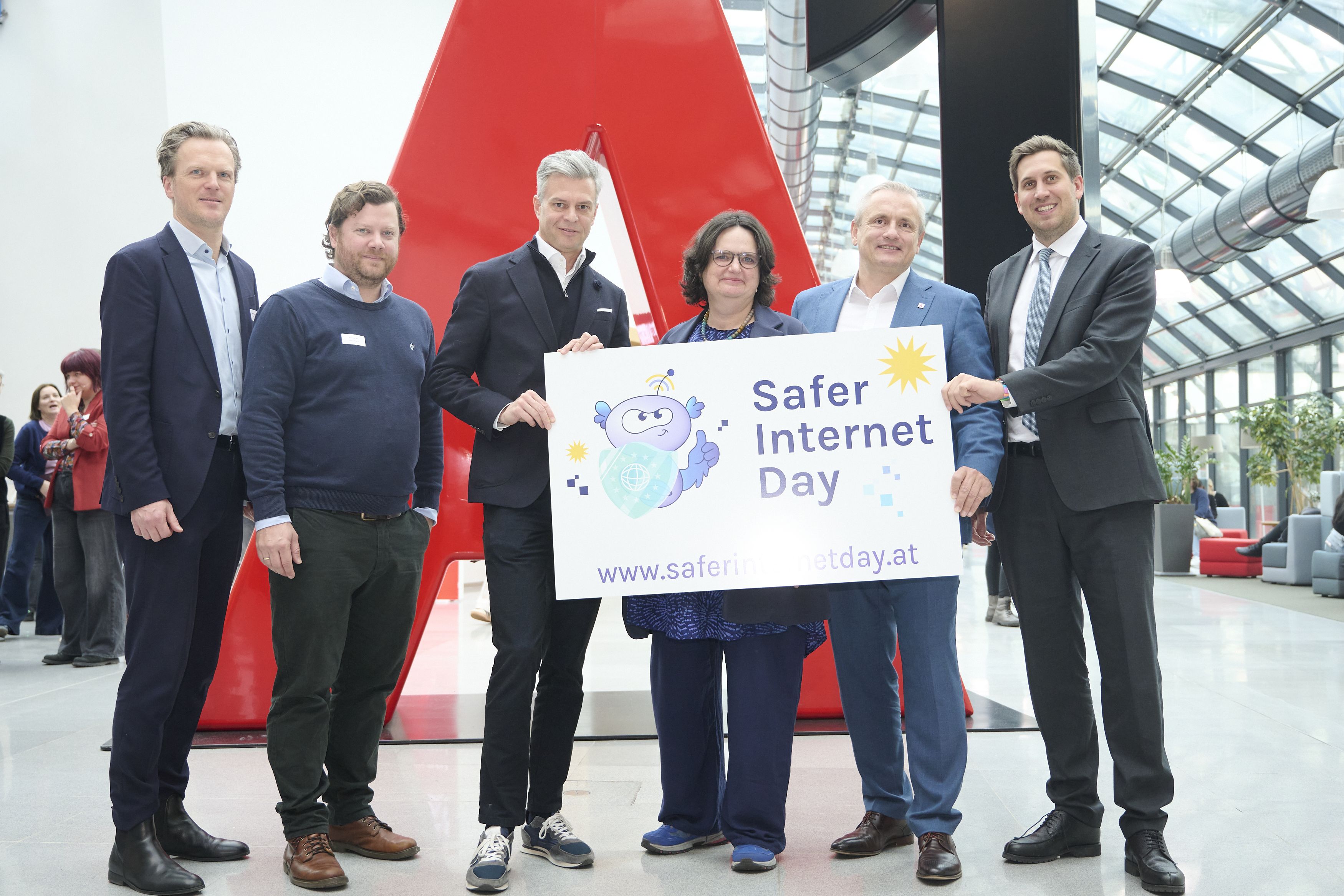
The symposium focused on AI applications as everyday companions for young people – a topic that was also addressed in the study on AI companions for Safer Internet Day 2026 (original article in German) and was taken up in the opening speeches. Jiří Dvorjančanský, CEO of A1 Telekom Austria, a long-standing partner of Saferinternet.at and host of the event, pointed out the need for more education on AI applications and their risks and underlined A1's strong commitment in this area.
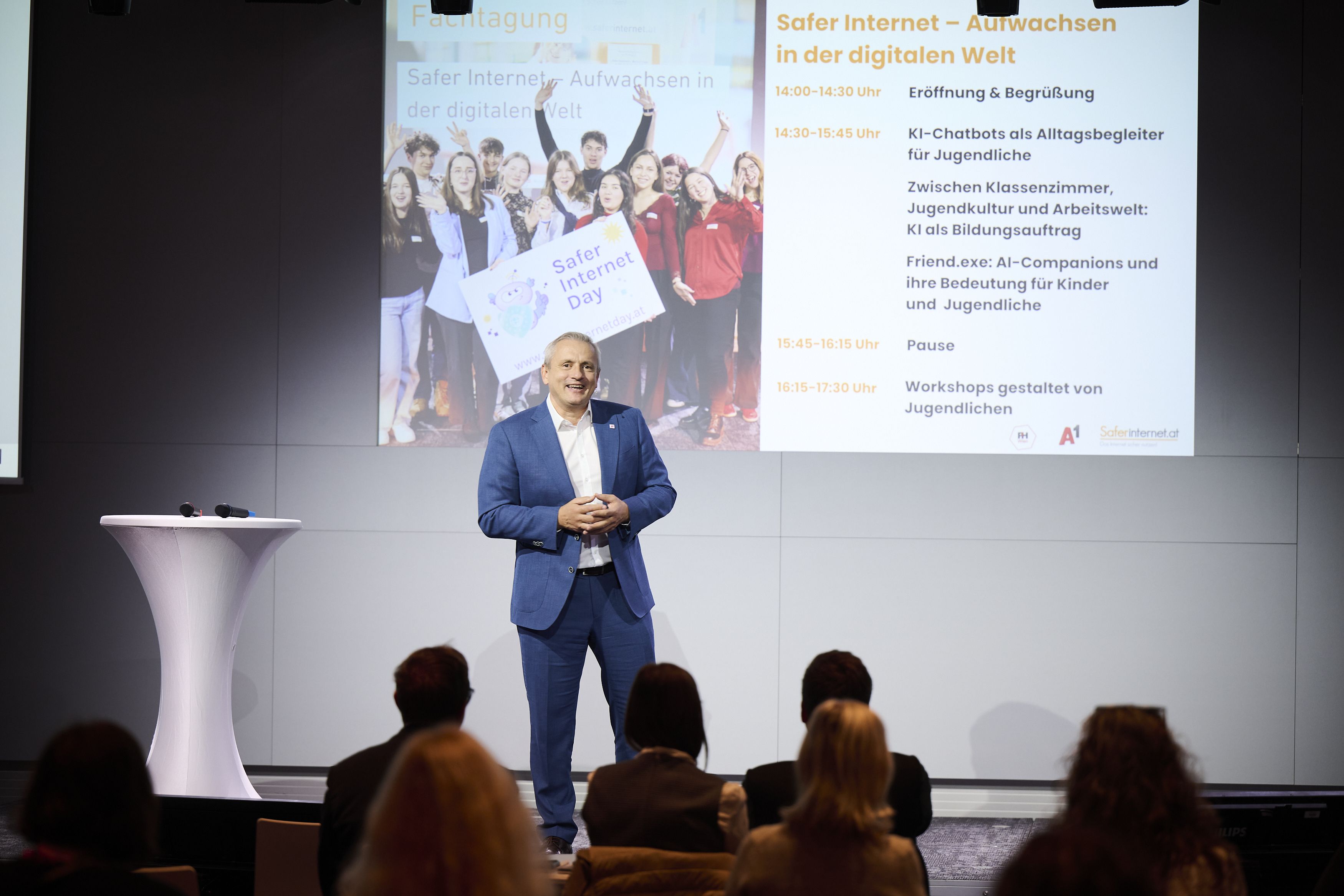
In his opening speech, Austria's State Secretary for Digitalisation, Alexander Pröll, also addressed the importance of media literacy, which is becoming increasingly important in view of the digital transformation and the rapid development of AI. In his speech, Pröll advocated regulatory measures such as the much-discussed social media ban, but at the same time spoke out in favour of promoting media literacy in schools and through measures such as the Digital Competence Offensive.
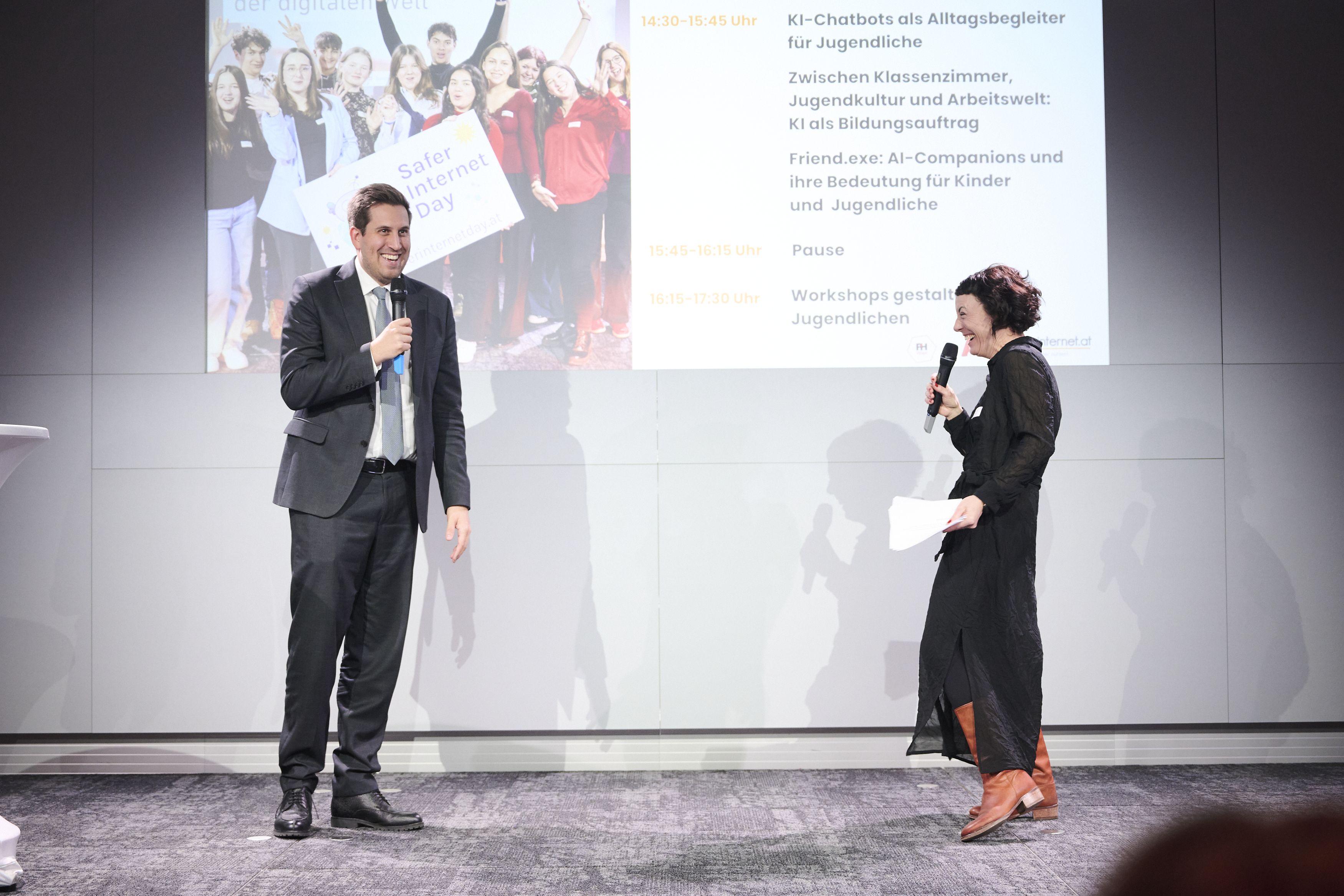
Pröll also emphasised how important it is, especially when it comes to the social media ban, to listen to the voices of the young people affected and to include their opinions in the decision-making process. The State Secretary seized the opportunity to engage in direct dialogue with young people immediately afterwards: he invited those present at the Austrian Safer Internet Centre youth panel to a discussion round to hear what young people had to say on the subject – a valuable exchange for all involved.
AI chatbots as everyday companions for young people
Social education worker Christine Piriwe from Rat auf Draht and the educational director of Saferinternet.at, Barbara Buchegger, highlighted how young people use AI chatbots for social interaction in the first expert presentation of the afternoon: in their insightful dialogue, they provided an insight into how young people use AI chatbots for social interaction. Enriched with many case studies from their counselling practice, they succeeded in making the added value that young people derive from communicating with chatbots tangible, while also highlighting the associated risks.
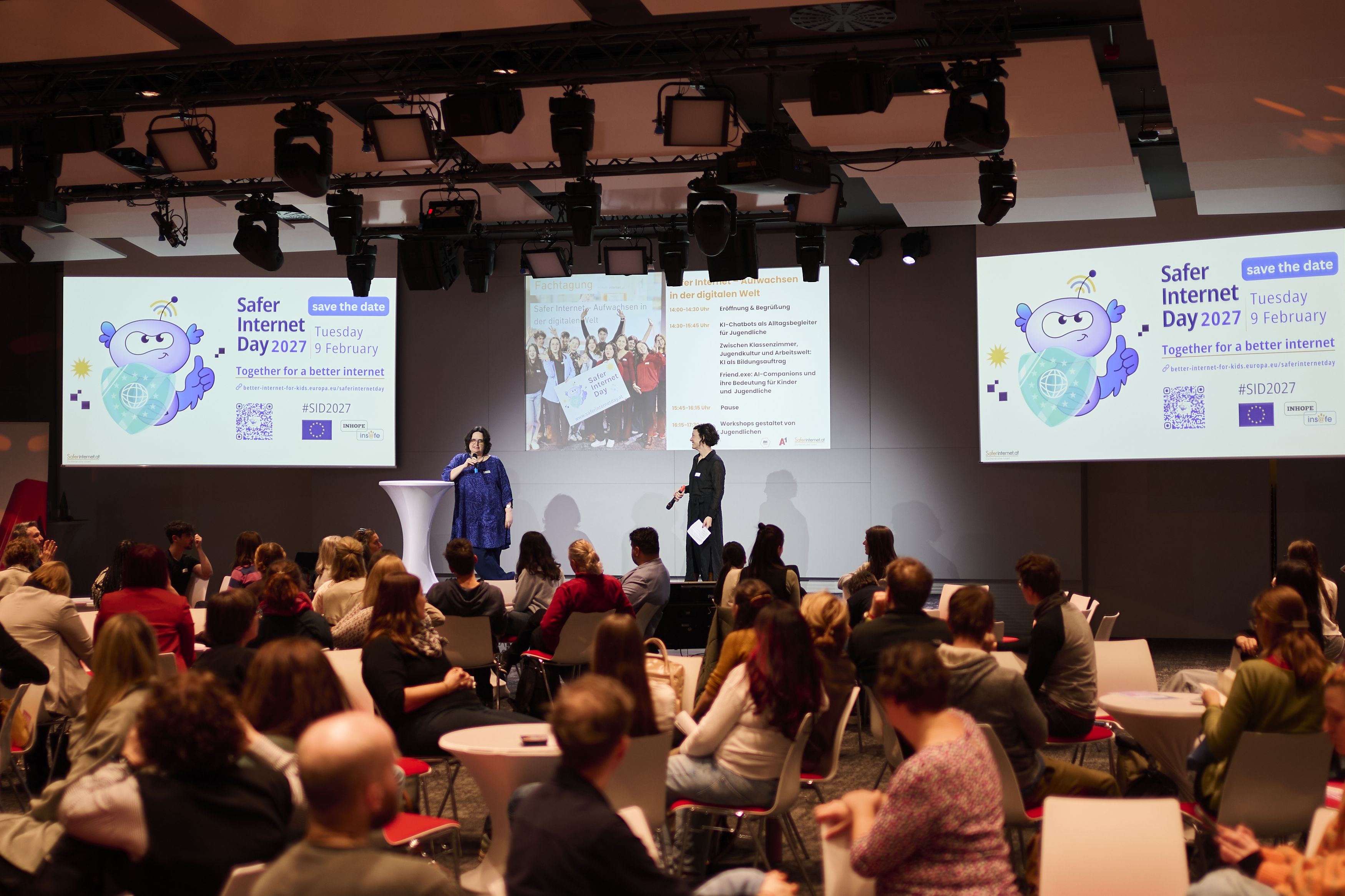
This highlighted how important it is to make young people aware of the limitations of AI systems: even though chatbots may be helpful as a first point of contact, they cannot provide the same level of support as real people when problems arise. The two speakers used accessible explanations and tips to illustrate how young people can be made to understand the importance of genuine communication.
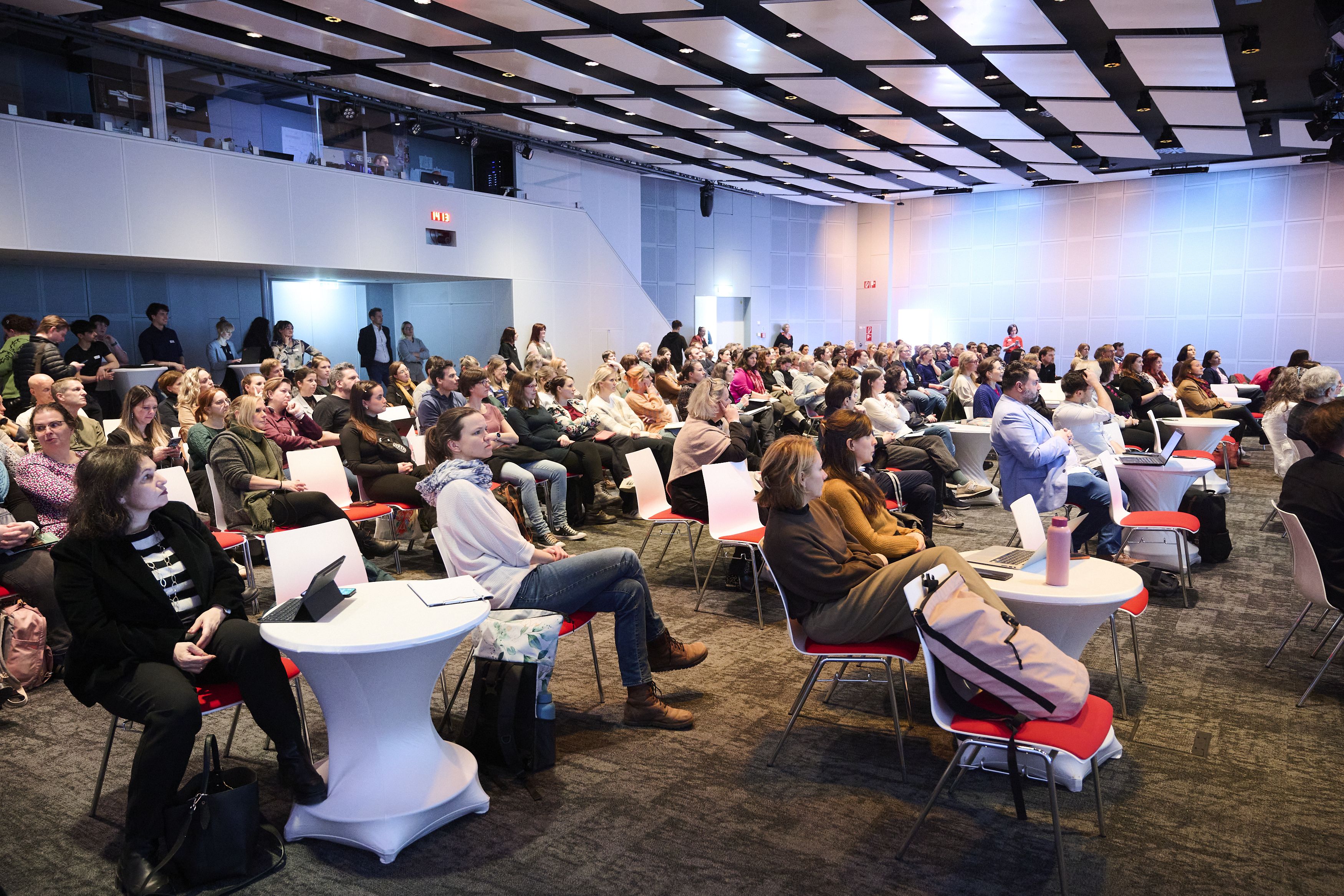
Between the classroom, youth culture and the world of work: AI as an educational mission
In the following presentation, Michaela Barta-Müller, Transformation Lead at A1, addressed the question of which AI skills are expected in the world of work and how young people can learn to use AI as a useful learning and working tool.
Using examples from the company A1, the expert provided insight into the status quo of AI in the world of work. It became clear that AI is already used in almost all areas of work today and that knowing how to use AI applications is therefore an essential skill for future employees.
Her presentation illustrated that this skill should involve more than just mastering AI tools. Barta-Müller identified asking good questions, being able to interpret results correctly and developing an attitude as the most important skills young people should learn in relation to AI. The conclusion of her insightful presentation was that using AI sensibly is not a technological issue, but an educational task.
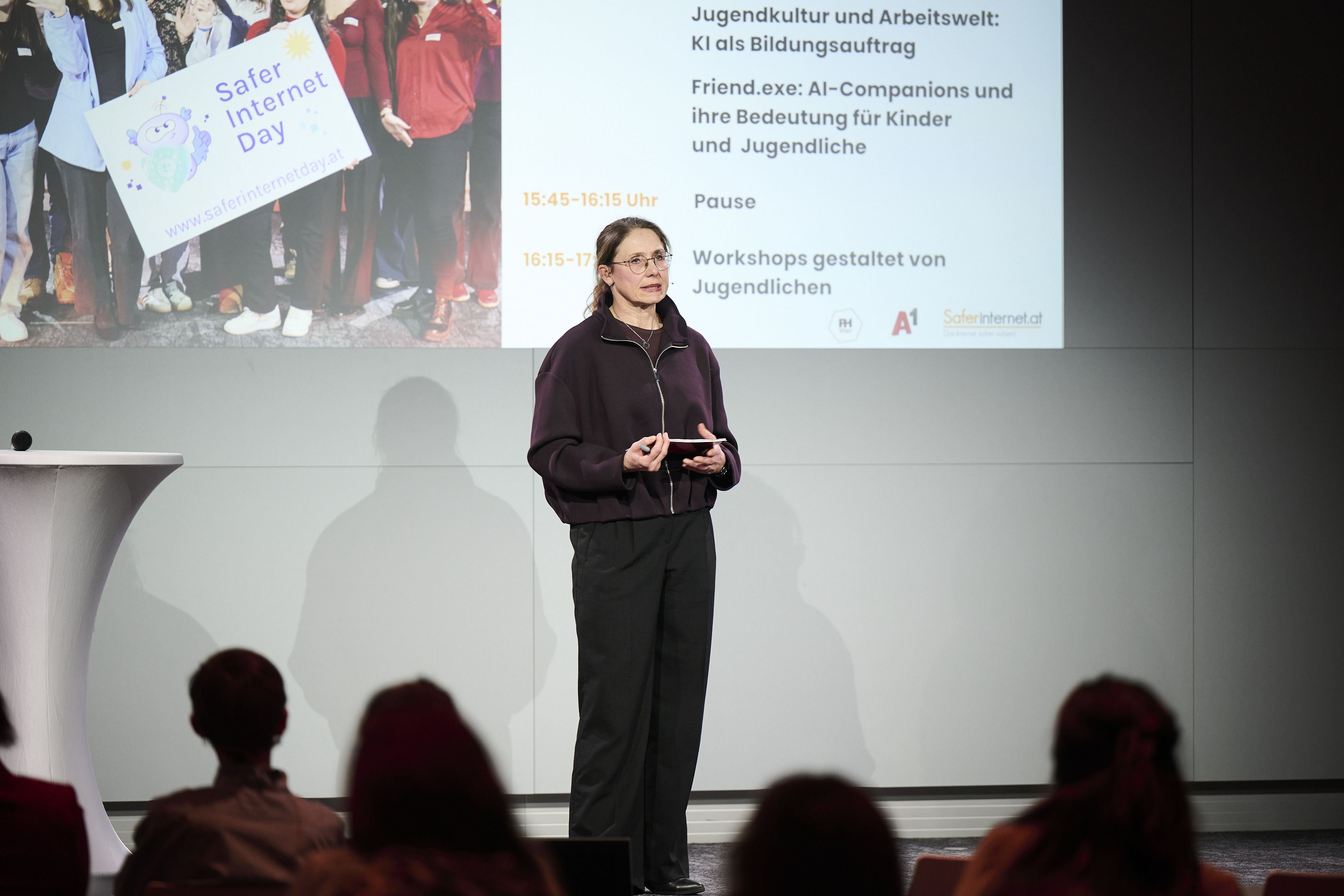
Friend.exe: AI companions and their significance for children and young people
Julia Krickl, Co-Head of Research at the Austrian Institute for Applied Telecommunications (ÖIAT), also addressed the increasing importance of AI chatbots for young people in the interpersonal sphere in her presentation. She highlighted the role and areas of application of emotional AI companions such as Character.AI, talkie and Mechat, and pointed out that minors currently have almost unrestricted access to such services – without effective age verification.
Without disregarding the potential positive effects of AI companions, the presentation addressed the risks of this development: the rabbit hole effect, emotional dependencies, problematic AI responses and possible effects on mental health and social relationships.
Against the backdrop of current figures, Krickl highlighted the urgent need for action: with the help of illustrative examples, she succeeded in making it clear why unregulated access for children under the age of 14 is irresponsible and why age-appropriate, pedagogically designed AI services are important.
Young people had their say as experts
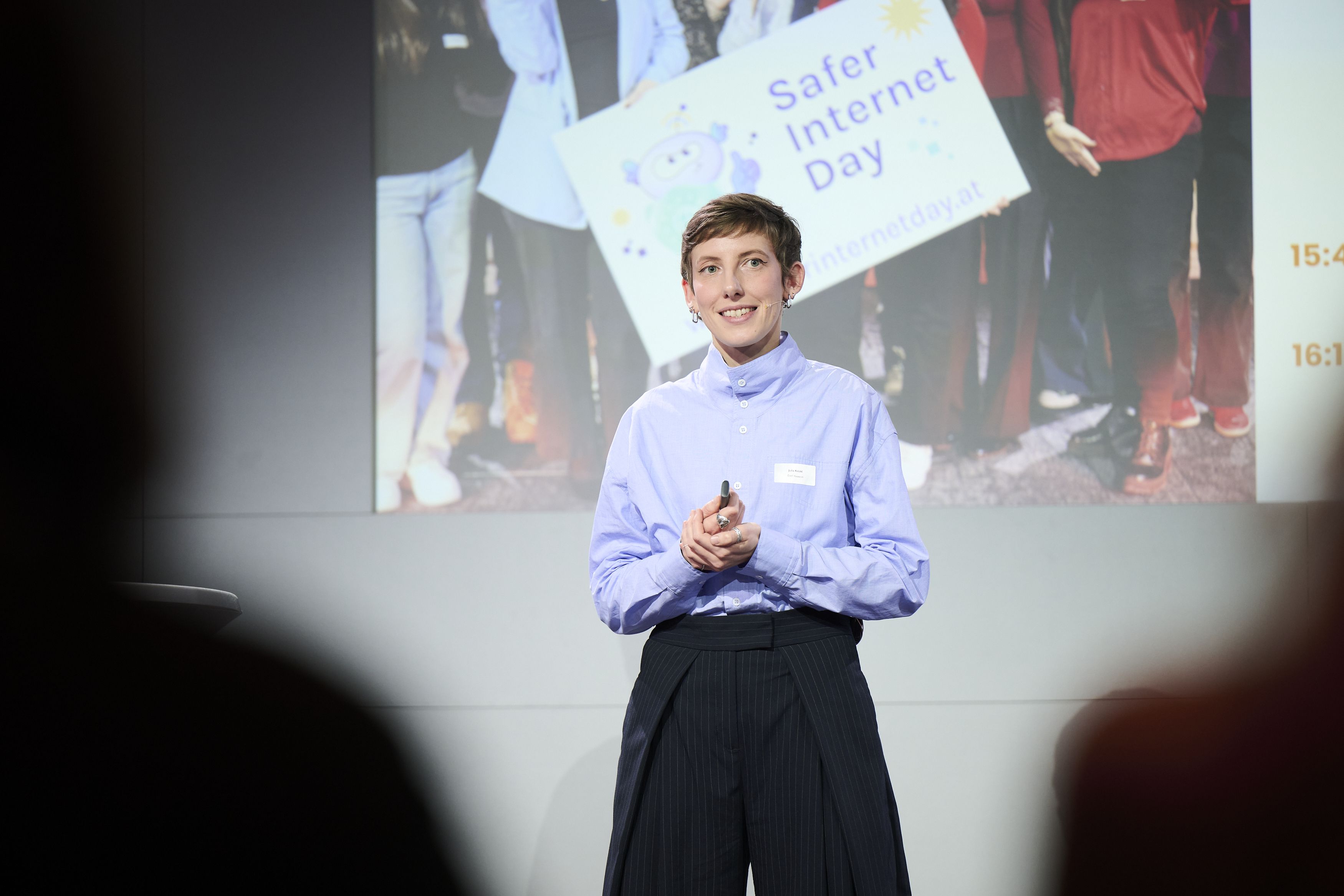
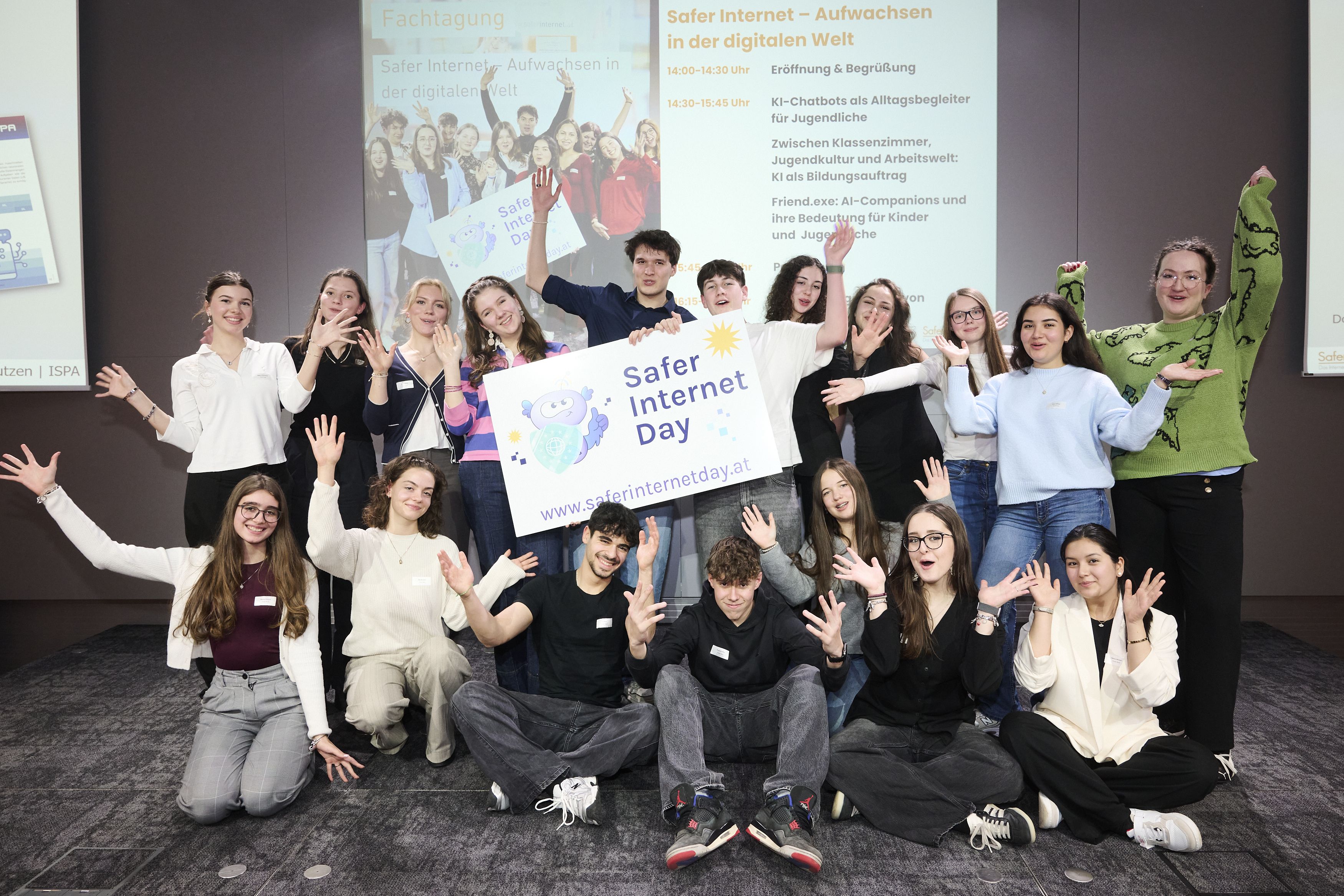
Which digital topics are particularly relevant for young people? And what should adults know about them? No one knows this better than young people themselves – which is why young people were also involved in the design and implementation of the symposium. Eighteen young people from the Austrian Safer Internet Centre youth panel designed a significant part of the programme themselves and worked together to develop six different themed stations: in table groups, they discussed with guests the portrayal of children online and cybergrooming, love scams, data protection and AI, chatbots as friends for young people, the use of AI at school and in everyday life, and algorithms and filter bubbles.
The guests were particularly impressed by the young people's knowledge of their topics and how well they were able to communicate it. During the table group discussions, those present were not only able to learn a great deal from the young people, but also gain very personal insights into their lives: the experiences that the young people themselves and those around them were able to share provided important input for the discussion of digital issues. The different perspectives that the young people and adults had on various aspects of digital life also made for an enriching exchange.
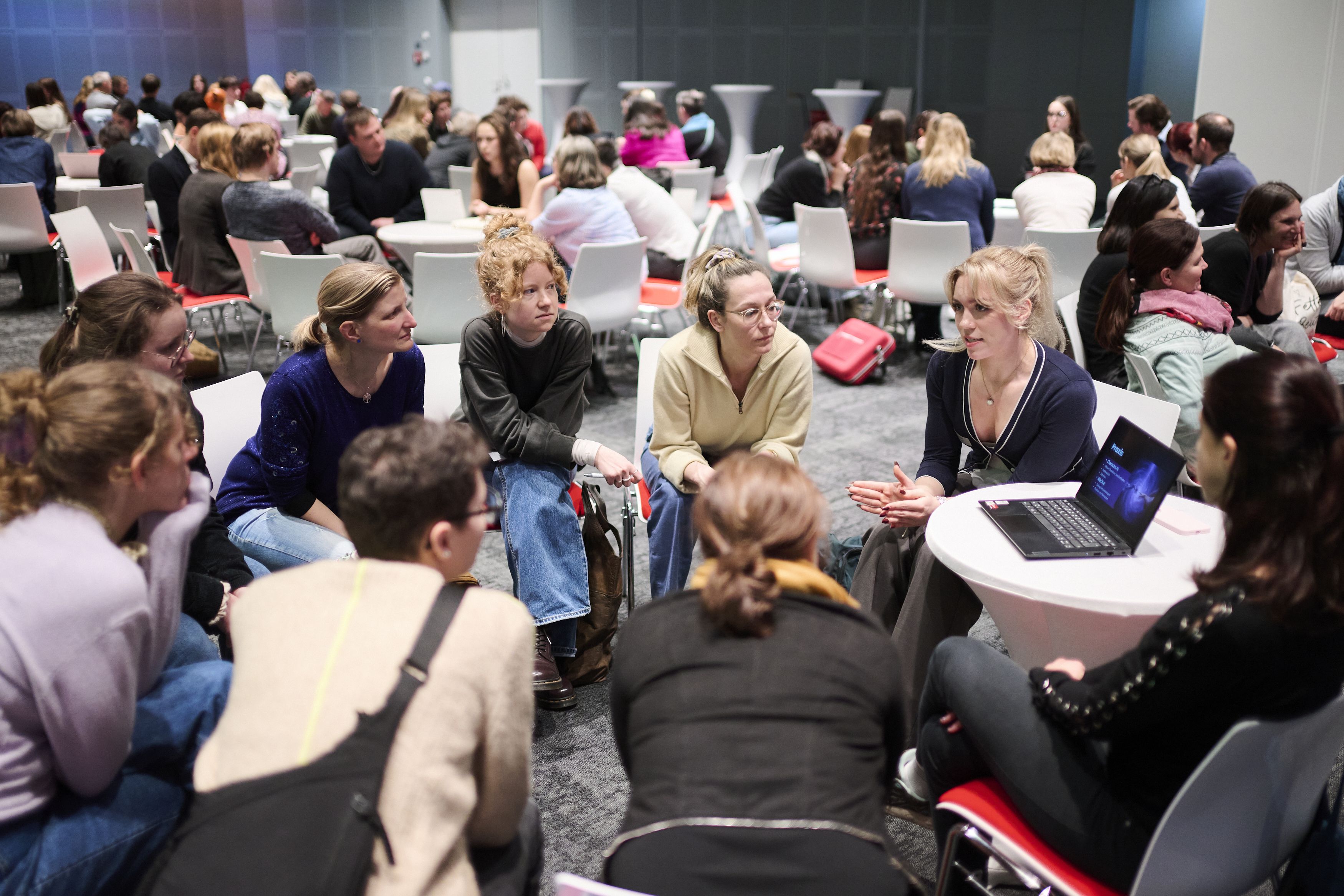
The discussions clearly showed how young people themselves assess the current situation: they feel that they are expected to navigate the internet safely on their own, recognise problematic or toxic content and not allow themselves to be manipulated. At the same time, they report a digital environment that is full of temptations, strongly focused on attention and not always transparent.
From the young people's point of view, the responsibility for this cannot lie solely with them. They want framework conditions that reduce risks, clearer rules for platforms and a more conscious approach to problematic content. For them, a safer internet does not primarily mean bans, but understandable explanations, guidance and support.
It became clear that young people want to be taken seriously – not as a risk group, but as competent users who are willing to take responsibility if society also does its part.
Read a review of the SID 2026 conference from the perspective of the youth panel.
An overview of past Saferinternet.at conferences is also available.
Find out more about Safer Internet Day in Austria. Alternatively, find more information about the work of the Austrian Safer Internet Centre, including its awareness raising, helpline, hotline, and youth participation services, or find similar information for other Safer Internet Centres throughout Europe.
More on internet usage, practices and engagement


Exciting presentations, panel discussions and plenty of opportunity for exchange – this was what the SID 2026 conference "Safer internet – growing up in the digital world" organised by the Austrian Safer Internet Centre had to offer, focusing on the everyday online lives of children and young people. Around 220 visitors attended the sold-out event, which took place in Vienna on 12 February 2026.
Safer internet – growing up in the digital world
The conference addressed key questions such as the challenges children and young people face on the internet and how to promote responsible use of digital media. The focus was on AI and its impact on young people's lives.
In addition to input from media experts, young people themselves contributed their perspectives and played a key role in shaping the symposium. In moderated table groups, they invited the audience to share their experiences and provided practical tips on topics such as artificial intelligence, love scams, cybergrooming and data protection. This gave guests a diverse and authentic insight into the digital world of young people.
Artificial intelligence as a central topic
The symposium focused on AI applications as everyday companions for young people – a topic that was also addressed in the study on AI companions for Safer Internet Day 2026 (original article in German) and was taken up in the opening speeches. Jiří Dvorjančanský, CEO of A1 Telekom Austria, a long-standing partner of Saferinternet.at and host of the event, pointed out the need for more education on AI applications and their risks and underlined A1's strong commitment in this area.
In his opening speech, Austria's State Secretary for Digitalisation, Alexander Pröll, also addressed the importance of media literacy, which is becoming increasingly important in view of the digital transformation and the rapid development of AI. In his speech, Pröll advocated regulatory measures such as the much-discussed social media ban, but at the same time spoke out in favour of promoting media literacy in schools and through measures such as the Digital Competence Offensive.
Pröll also emphasised how important it is, especially when it comes to the social media ban, to listen to the voices of the young people affected and to include their opinions in the decision-making process. The State Secretary seized the opportunity to engage in direct dialogue with young people immediately afterwards: he invited those present at the Austrian Safer Internet Centre youth panel to a discussion round to hear what young people had to say on the subject – a valuable exchange for all involved.
AI chatbots as everyday companions for young people
Social education worker Christine Piriwe from Rat auf Draht and the educational director of Saferinternet.at, Barbara Buchegger, highlighted how young people use AI chatbots for social interaction in the first expert presentation of the afternoon: in their insightful dialogue, they provided an insight into how young people use AI chatbots for social interaction. Enriched with many case studies from their counselling practice, they succeeded in making the added value that young people derive from communicating with chatbots tangible, while also highlighting the associated risks.
This highlighted how important it is to make young people aware of the limitations of AI systems: even though chatbots may be helpful as a first point of contact, they cannot provide the same level of support as real people when problems arise. The two speakers used accessible explanations and tips to illustrate how young people can be made to understand the importance of genuine communication.
Between the classroom, youth culture and the world of work: AI as an educational mission
In the following presentation, Michaela Barta-Müller, Transformation Lead at A1, addressed the question of which AI skills are expected in the world of work and how young people can learn to use AI as a useful learning and working tool.
Using examples from the company A1, the expert provided insight into the status quo of AI in the world of work. It became clear that AI is already used in almost all areas of work today and that knowing how to use AI applications is therefore an essential skill for future employees.
Her presentation illustrated that this skill should involve more than just mastering AI tools. Barta-Müller identified asking good questions, being able to interpret results correctly and developing an attitude as the most important skills young people should learn in relation to AI. The conclusion of her insightful presentation was that using AI sensibly is not a technological issue, but an educational task.
Friend.exe: AI companions and their significance for children and young people
Julia Krickl, Co-Head of Research at the Austrian Institute for Applied Telecommunications (ÖIAT), also addressed the increasing importance of AI chatbots for young people in the interpersonal sphere in her presentation. She highlighted the role and areas of application of emotional AI companions such as Character.AI, talkie and Mechat, and pointed out that minors currently have almost unrestricted access to such services – without effective age verification.
Without disregarding the potential positive effects of AI companions, the presentation addressed the risks of this development: the rabbit hole effect, emotional dependencies, problematic AI responses and possible effects on mental health and social relationships.
Against the backdrop of current figures, Krickl highlighted the urgent need for action: with the help of illustrative examples, she succeeded in making it clear why unregulated access for children under the age of 14 is irresponsible and why age-appropriate, pedagogically designed AI services are important.
Young people had their say as experts
Which digital topics are particularly relevant for young people? And what should adults know about them? No one knows this better than young people themselves – which is why young people were also involved in the design and implementation of the symposium. Eighteen young people from the Austrian Safer Internet Centre youth panel designed a significant part of the programme themselves and worked together to develop six different themed stations: in table groups, they discussed with guests the portrayal of children online and cybergrooming, love scams, data protection and AI, chatbots as friends for young people, the use of AI at school and in everyday life, and algorithms and filter bubbles.
The guests were particularly impressed by the young people's knowledge of their topics and how well they were able to communicate it. During the table group discussions, those present were not only able to learn a great deal from the young people, but also gain very personal insights into their lives: the experiences that the young people themselves and those around them were able to share provided important input for the discussion of digital issues. The different perspectives that the young people and adults had on various aspects of digital life also made for an enriching exchange.
The discussions clearly showed how young people themselves assess the current situation: they feel that they are expected to navigate the internet safely on their own, recognise problematic or toxic content and not allow themselves to be manipulated. At the same time, they report a digital environment that is full of temptations, strongly focused on attention and not always transparent.
From the young people's point of view, the responsibility for this cannot lie solely with them. They want framework conditions that reduce risks, clearer rules for platforms and a more conscious approach to problematic content. For them, a safer internet does not primarily mean bans, but understandable explanations, guidance and support.
It became clear that young people want to be taken seriously – not as a risk group, but as competent users who are willing to take responsibility if society also does its part.
Read a review of the SID 2026 conference from the perspective of the youth panel.
An overview of past Saferinternet.at conferences is also available.
Find out more about Safer Internet Day in Austria. Alternatively, find more information about the work of the Austrian Safer Internet Centre, including its awareness raising, helpline, hotline, and youth participation services, or find similar information for other Safer Internet Centres throughout Europe.
- Safer Internet Day (SID) SID artificial intelligence (AI)
Related content
- < Previous article
- Next article >
More on internet usage, practices and engagement
- < Previous
- Next >
More on internet usage, practices and engagement
Related articles


