
Jad, from the Austrian youth panel, provides insights into youth participation at the Safer Internet Day conference in Austria “Safer internet – growing up in the digital world”.

Months of preparation, intensive discussions and honest dialogue on equal footing: at the Safer Internet Day 2026 conference, the Austrian youth panel organised workshops for adults and created spaces for exchange. This is a personal review of a special day.
From the idea to the great day
“Do we still live in the same world as our parents?”
This question accompanied us throughout the preparations for the Safer Internet Day 2026 conference.
The conference was months of intensive work for us: numerous online meetings, concept development, discussions and fine-tuning. The preparations were sometimes long and exhausting, but worthwhile in the end. Although we were nervous, the anticipation prevailed.
Exchange with State Secretary Pröll
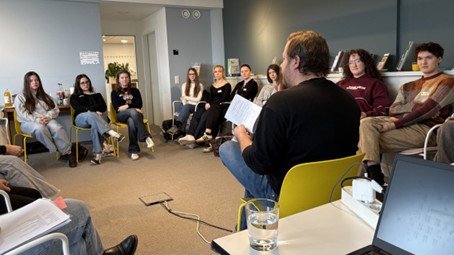
After the opening by State Secretary Alexander Pröll, we had the opportunity to talk to him about age restrictions for social media in Austria. Even though we did not agree on all points, one thing became clear: the issues are more complex than they appear at first glance, and there are many different perspectives on them.
This open exchange showed how important youth participation is.
The workshops
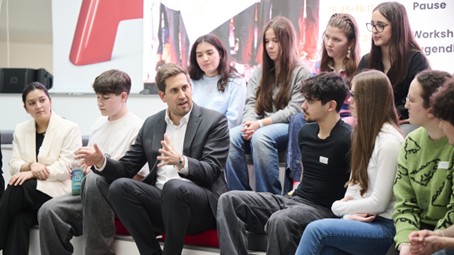
After the official introduction and keynotes, our workshops began. In small groups, we spent 15 minutes discussing the following topics with adults:
- Depictions of children online and cybergrooming
- Love scams
- “ChatBF” – When AI becomes your friend
- Childhood in the matrix – left or right pill?
- Data protection
- Use of AI in school & everyday life
We were struck by the fact that the realities of life for young people and adults sometimes differ greatly. While we take many digital developments for granted, they often seem new or difficult to understand to older generations.
But that is precisely what made the discussions so valuable. The different perspectives did not create distance but meaningful dialogue.
After the first round, the groups switched so that we supervised a total of two groups per person. Time was short, but the discussions were intense and open.
Our “UNO reverse” card: a change of perspective
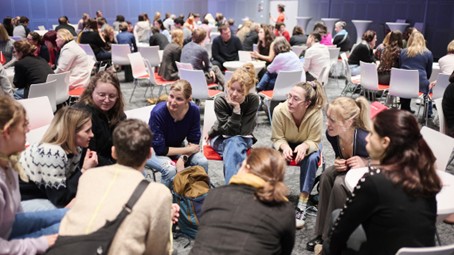
The discussions were followed by a moderated phase in which some participants shared their findings with all participants. Our “UNO reverse” (a reference to the direction-change-card from the game UNO) was exciting. This time, it was the adults' turn: they had to report on what they had learned, while the young people asked the questions.
This change of perspective was a strong sign that youth participation does not only mean being heard, but also making others think.
The sweets experiment
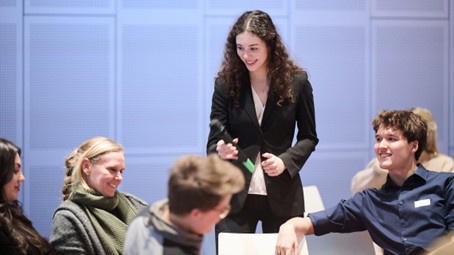
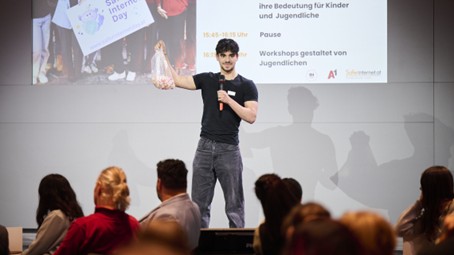
At the end, I was allowed to reveal the results of a little experiment: at the beginning of the conference, we had given sweets to the adults without any further explanation. Most of them simply accepted them without looking at the list of ingredients or the package insert.
This was our metaphor for the internet.
Every day, we give young people digital content and at the same time expect them to recognise for themselves which content is problematic, what risks it poses and which they should ‘filter out’. But without sufficient information, guidance and media education, this is impossible.
The experiment revealed how we naturally consume content both online and offline.
In the end, it became clear that if we want children to navigate the internet responsibly, we must first take responsibility ourselves – and that only works by explaining things to them.
What youth participation means to me
For me, youth participation means not only being invited, but also being taken seriously. It means contributing my own perspectives, taking responsibility and actively helping to shape things.
The Safer Internet Day 2026 conference showed that when young people are given space, new perspectives, honest conversations and mutual understanding emerge.
So do we still live in the same world as our parents?
Perhaps not entirely.
But that is precisely why it is so important to talk about it with each other.
This article was originally published on the website of the Austrian Safer Internet Centre, and is repurposed here with permission.
Find out more about youth participation on the BIK Youth section of the portal.
Find more information about the work of the Austrian Safer Internet Centre, including its awareness raising, helpline, hotline, and youth participation services, or find similar information for other Safer Internet Centres throughout Europe.
More on internet usage, practices and engagement


Jad, from the Austrian youth panel, provides insights into youth participation at the Safer Internet Day conference in Austria “Safer internet – growing up in the digital world”.
Months of preparation, intensive discussions and honest dialogue on equal footing: at the Safer Internet Day 2026 conference, the Austrian youth panel organised workshops for adults and created spaces for exchange. This is a personal review of a special day.
From the idea to the great day
“Do we still live in the same world as our parents?”
This question accompanied us throughout the preparations for the Safer Internet Day 2026 conference.
The conference was months of intensive work for us: numerous online meetings, concept development, discussions and fine-tuning. The preparations were sometimes long and exhausting, but worthwhile in the end. Although we were nervous, the anticipation prevailed.
Exchange with State Secretary Pröll
After the opening by State Secretary Alexander Pröll, we had the opportunity to talk to him about age restrictions for social media in Austria. Even though we did not agree on all points, one thing became clear: the issues are more complex than they appear at first glance, and there are many different perspectives on them.
This open exchange showed how important youth participation is.
The workshops
After the official introduction and keynotes, our workshops began. In small groups, we spent 15 minutes discussing the following topics with adults:
- Depictions of children online and cybergrooming
- Love scams
- “ChatBF” – When AI becomes your friend
- Childhood in the matrix – left or right pill?
- Data protection
- Use of AI in school & everyday life
We were struck by the fact that the realities of life for young people and adults sometimes differ greatly. While we take many digital developments for granted, they often seem new or difficult to understand to older generations.
But that is precisely what made the discussions so valuable. The different perspectives did not create distance but meaningful dialogue.
After the first round, the groups switched so that we supervised a total of two groups per person. Time was short, but the discussions were intense and open.
Our “UNO reverse” card: a change of perspective
The discussions were followed by a moderated phase in which some participants shared their findings with all participants. Our “UNO reverse” (a reference to the direction-change-card from the game UNO) was exciting. This time, it was the adults' turn: they had to report on what they had learned, while the young people asked the questions.
This change of perspective was a strong sign that youth participation does not only mean being heard, but also making others think.
The sweets experiment
At the end, I was allowed to reveal the results of a little experiment: at the beginning of the conference, we had given sweets to the adults without any further explanation. Most of them simply accepted them without looking at the list of ingredients or the package insert.
This was our metaphor for the internet.
Every day, we give young people digital content and at the same time expect them to recognise for themselves which content is problematic, what risks it poses and which they should ‘filter out’. But without sufficient information, guidance and media education, this is impossible.
The experiment revealed how we naturally consume content both online and offline.
In the end, it became clear that if we want children to navigate the internet responsibly, we must first take responsibility ourselves – and that only works by explaining things to them.
What youth participation means to me
For me, youth participation means not only being invited, but also being taken seriously. It means contributing my own perspectives, taking responsibility and actively helping to shape things.
The Safer Internet Day 2026 conference showed that when young people are given space, new perspectives, honest conversations and mutual understanding emerge.
So do we still live in the same world as our parents?
Perhaps not entirely.
But that is precisely why it is so important to talk about it with each other.
This article was originally published on the website of the Austrian Safer Internet Centre, and is repurposed here with permission.
Find out more about youth participation on the BIK Youth section of the portal.
Find more information about the work of the Austrian Safer Internet Centre, including its awareness raising, helpline, hotline, and youth participation services, or find similar information for other Safer Internet Centres throughout Europe.
- Safer Internet Day (SID) youth empowerment youth participation
Related content
- < Previous article
- Next article >
More on internet usage, practices and engagement
Related articles


