
Safer Internet Day 2026 was once again celebrated across Greece, bringing together the educational community, public authorities, and stakeholders in a dynamic nationwide effort to promote a safer digital environment for children and young people. The celebrations were coordinated in Greece by the Greek Safer Internet Centre (SaferInternet4Kids.gr) of FORTH, which organised a wide range of activities and initiatives, turning the day into a true national campaign of awareness and engagement.

More than 5,000 schools actively took part through creative actions, national student competitions, and educational events organised either independently or in collaboration with the cybercrime division of the Greek police and the Greek school network. Two major central events were held, one at the Peace and Friendship Stadium in Athens, and another at FORTH in Crete, bringing together over 1,200 students who became the true protagonists of the day.
The atmosphere was vibrant and inspiring, highlighting the vital role young people play in shaping a safer and more responsible digital future. The Minister of Social Cohesion and Family, Domna Michailidou, attended the event and emphasised that in a world where children’s lives increasingly unfold online, digital safety is a cornerstone of social cohesion, equal opportunities, and the meaningful protection of childhood. The regional governor of Attica, Nikos Hardalias, emphasised the importance of raising awareness and keeping the public informed on issues related to online safety. He also praised the work of the Greek Safer Internet Centre, highlighting its valuable contribution at national level.
A particularly engaging moment was the open discussion between well-known actress and Safer Internet ambassador Vaso Laskaraki and the students. Speaking with honesty and immediacy, she addressed the real challenges of online presence and encouraged children to practice self-protection, think critically, and, most importantly, communicate openly with trusted adults whenever something online makes them feel uncomfortable or unsafe.
Presentations by SIC Greece Coordinator Vivi Fragopoulou and team member Giorgos Kormas focused on tackling cyberbullying and raising awareness of the immediate support mechanisms available to children and adolescents, such as the national helpline. Both stressed a key message: no child is alone online, and seeking help early can prevent difficult situations from escalating.
The event concluded with awards presented to the winners of the student competitions “Artificial intelligence in our lives” and “Capture the flag”, the latter organised under the auspices of the National Cybersecurity Authority. The awards showcased students’ creativity, critical thinking, and digital skills, demonstrating that the younger generation can embrace technology with responsibility and innovation.
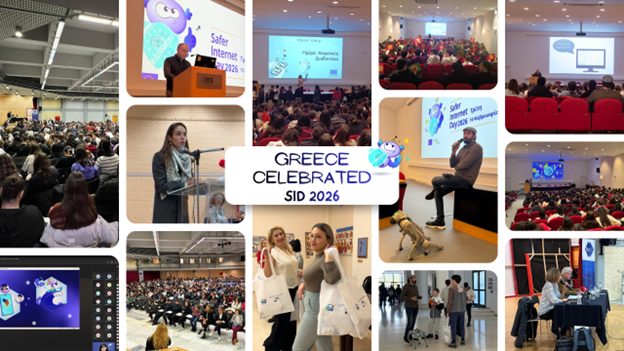
At the same time, in Heraklion, students participated in hands-on experiential workshops exploring key digital age topics such as personal data protection, responsible online communication, identifying misinformation, and fostering positive digital behaviour. Their interaction with a robot developed by the Computational Vision and Robotics Laboratory sparked excitement and curiosity, offering a glimpse into how intelligent technologies “see” and “learn.”
Across the country, hundreds of additional schools used Safer Internet Day educational materials developed for the occasion to organise their own awareness activities. The supporters’ map quickly filled with contributions from every corner of Greece, vividly illustrating the widespread participation and collective commitment to building a better and safer internet for children.
While 10 February marked the highlight of the celebrations, the momentum continues throughout the month, with further events and initiatives planned for students, parents, and educators nationwide reinforcing the message that online safety is not just a single day, but an ongoing shared responsibility.
Find out more about Safer Internet Day in Greece. Alternatively, find more information about the work of the Greek Safer Internet Centre, including its awareness raising, helpline, hotline, and youth participation services, or find similar information for other Safer Internet Centres throughout Europe.
More on internet usage, practices and engagement


Safer Internet Day 2026 was once again celebrated across Greece, bringing together the educational community, public authorities, and stakeholders in a dynamic nationwide effort to promote a safer digital environment for children and young people. The celebrations were coordinated in Greece by the Greek Safer Internet Centre (SaferInternet4Kids.gr) of FORTH, which organised a wide range of activities and initiatives, turning the day into a true national campaign of awareness and engagement.
More than 5,000 schools actively took part through creative actions, national student competitions, and educational events organised either independently or in collaboration with the cybercrime division of the Greek police and the Greek school network. Two major central events were held, one at the Peace and Friendship Stadium in Athens, and another at FORTH in Crete, bringing together over 1,200 students who became the true protagonists of the day.
The atmosphere was vibrant and inspiring, highlighting the vital role young people play in shaping a safer and more responsible digital future. The Minister of Social Cohesion and Family, Domna Michailidou, attended the event and emphasised that in a world where children’s lives increasingly unfold online, digital safety is a cornerstone of social cohesion, equal opportunities, and the meaningful protection of childhood. The regional governor of Attica, Nikos Hardalias, emphasised the importance of raising awareness and keeping the public informed on issues related to online safety. He also praised the work of the Greek Safer Internet Centre, highlighting its valuable contribution at national level.
A particularly engaging moment was the open discussion between well-known actress and Safer Internet ambassador Vaso Laskaraki and the students. Speaking with honesty and immediacy, she addressed the real challenges of online presence and encouraged children to practice self-protection, think critically, and, most importantly, communicate openly with trusted adults whenever something online makes them feel uncomfortable or unsafe.
Presentations by SIC Greece Coordinator Vivi Fragopoulou and team member Giorgos Kormas focused on tackling cyberbullying and raising awareness of the immediate support mechanisms available to children and adolescents, such as the national helpline. Both stressed a key message: no child is alone online, and seeking help early can prevent difficult situations from escalating.
The event concluded with awards presented to the winners of the student competitions “Artificial intelligence in our lives” and “Capture the flag”, the latter organised under the auspices of the National Cybersecurity Authority. The awards showcased students’ creativity, critical thinking, and digital skills, demonstrating that the younger generation can embrace technology with responsibility and innovation.
At the same time, in Heraklion, students participated in hands-on experiential workshops exploring key digital age topics such as personal data protection, responsible online communication, identifying misinformation, and fostering positive digital behaviour. Their interaction with a robot developed by the Computational Vision and Robotics Laboratory sparked excitement and curiosity, offering a glimpse into how intelligent technologies “see” and “learn.”
Across the country, hundreds of additional schools used Safer Internet Day educational materials developed for the occasion to organise their own awareness activities. The supporters’ map quickly filled with contributions from every corner of Greece, vividly illustrating the widespread participation and collective commitment to building a better and safer internet for children.
While 10 February marked the highlight of the celebrations, the momentum continues throughout the month, with further events and initiatives planned for students, parents, and educators nationwide reinforcing the message that online safety is not just a single day, but an ongoing shared responsibility.
Find out more about Safer Internet Day in Greece. Alternatively, find more information about the work of the Greek Safer Internet Centre, including its awareness raising, helpline, hotline, and youth participation services, or find similar information for other Safer Internet Centres throughout Europe.
- Safer Internet Day (SID) SID
Related content
- < Previous article
- Next article >
More on internet usage, practices and engagement
- < Previous
- Next >
More on internet usage, practices and engagement
Related articles


