
For the second year in a row, A1 Croatia and Safer Internet Centre Croatia brought together international experts in cybersecurity and child protection at the CyberGuard 2025 Conference, held last year in October. With the support of relevant institutions, experts opened a discussion on protection and responsible online behaviour in light of the growing number of online threats.

For the second year in a row, A1 Croatia and Safer Internet Centre Croatia brought together international experts in cybersecurity and child protection at the CyberGuard 2025 Conference, held on 2 October 2025 at the Mozaik Event Centre in Zagreb. With the support of relevant institutions, experts opened a discussion on protection and responsible online behaviour in light of the growing number of online threats.
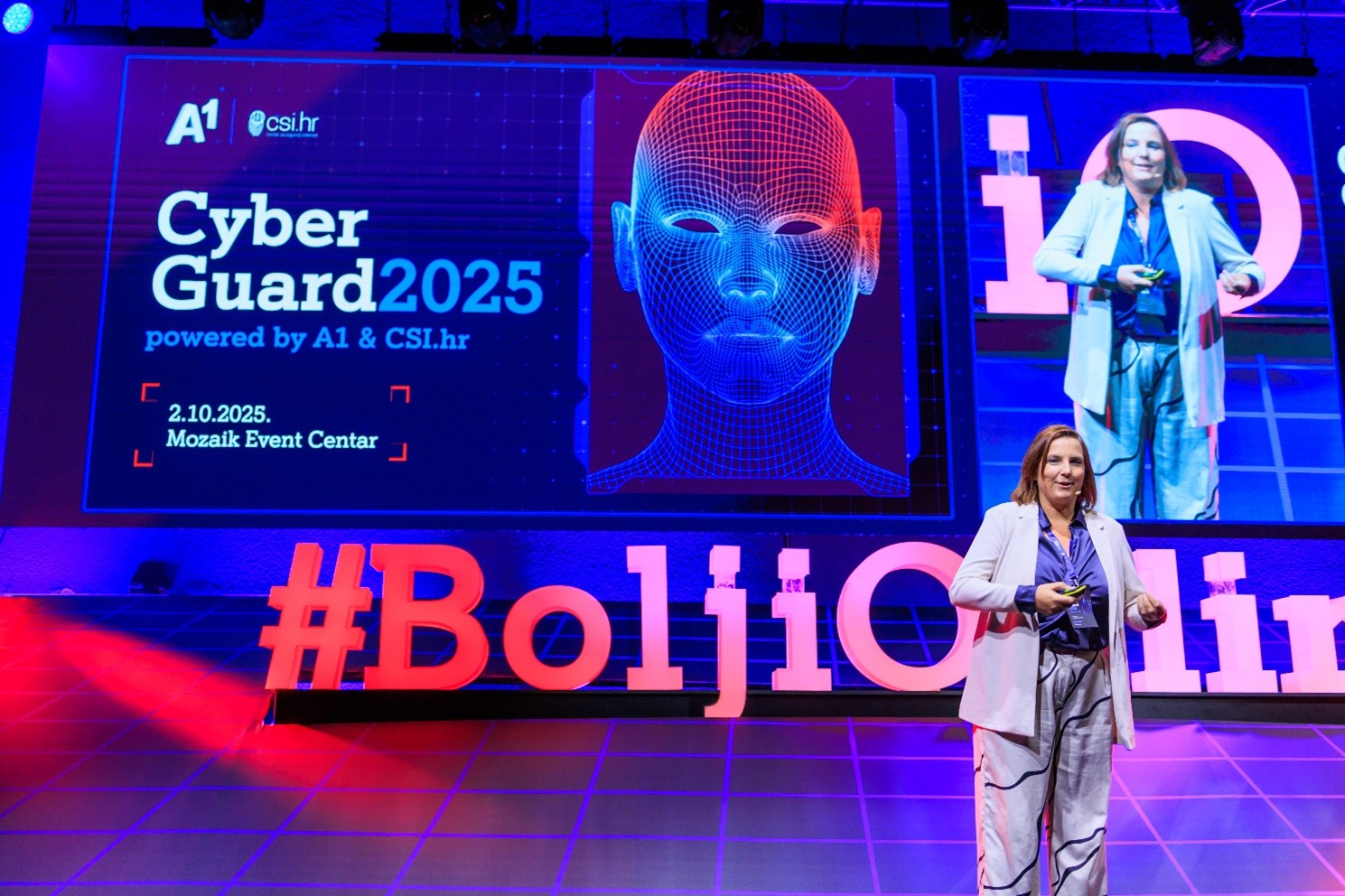
At the very beginning of the conference, the importance of cross-sectoral and international cooperation in combating cyber threats and creating a safer digital environment was emphasised. Among those addressing this issue, alongside hosts Dejan Turk, CEO of A1 Croatia and A1 Slovenia, and Tomislav Ramljak, Head of the Safer Internet Centre Croatia, were the Minister of Labour, Pension System, Family and Social Policy, Marin Piletić, Minister of Justice, Administration and Digital Transformation, Damir Habijan, and UK Ambassador to Croatia, Javed Patel.
“The online safety of children and young people is one of the key issues of our time, and the number of reports we receive at the Centre for Safer Internet shows that online violence and manipulation are still on the rise. Our goal is to provide children with protection and a safe environment to grow up in while empowering parents and teachers to be part of the solution. The CyberGuard 2025 Conference is crucial as it presents the results of the first national study on electronic violence, and only through joint action can we create a safer internet for children.” said Tomislav Ramljak, Head of the Centre for Safer Internet.
As part of the conference, Assoc. Prof. Lucija Vejmelka, Ph.D., from the Faculty of Law, University of Zagreb, presented the results of a study on peer and online violence among primary school students in Croatia, revealing that more than one-third of children (34.2%) experience electronic violence at least once a month, while a quarter (24.1%) perpetrate it during the same period. Particularly concerning is the finding that over a quarter of students have received sexual or inappropriate content from strangers online, and that almost one in seven children (14.8%) have arranged an in-person meeting with a stranger they met on the internet.

The findings were discussed in a panel featuring Denis Rukavina, Cybersecurity Police Officer; Prof. Zvonimir Paštar, M.D., Ph.D., Psychiatrist at Vrapče Psychiatric Hospital; and Iva Ančić, Head of Brand, Marketing Communications and Digital Business at A1 Croatia. The discussion underlined the importance of early and continuous prevention as well as education tailored to children, parents, and teachers.
The conference addressed the topics of child online safety and corporate cybersecurity from multiple perspectives. Among the speakers were Caitlin Jenkins-Watson, Head of the Child Sexual Abuse Threat Response Department at the UK’s National Crime Agency; Nel Broothaerts, CEO of Child Focus; Mick Moran, CEO of Irish Internet Hotline; Chris Hughes, Hotline Director, IWF - Internet Watch Foundation; Hrvoje Pavičić, Head of Security for Southeast Europe at IBM; and Nikola Dujmović, CEO of SPAN.
By placing online safety within both educational and corporate contexts, the CyberGuard Conference once again underscored the need for partnership between civil, business, and government sectors in building a society resilient to cyber threats.
As part of the conference, Assoc. Prof. Lucija Vejmelka, Ph.D., from the Faculty of Law, University of Zagreb, presented the results of a study on peer and online violence among primary school students in Croatia, revealing that more than one-third of children (34.2%) experience electronic violence at least once a month, while a quarter (24.1%) perpetrate it during the same period. Particularly concerning is the finding that over a quarter of students have received sexual or inappropriate content from strangers online, and that almost one in seven children (14.8%) have arranged an in-person meeting with a stranger they met on the internet.
The findings were discussed in a panel featuring Denis Rukavina, Cybersecurity Police Officer; Prof. Zvonimir Paštar, M.D., Ph.D., Psychiatrist at Vrapče Psychiatric Hospital; and Iva Ančić, Head of Brand, Marketing Communications and Digital Business at A1 Croatia. The discussion underlined the importance of early and continuous prevention as well as education tailored to children, parents, and teachers.
The conference addressed the topics of child online safety and corporate cybersecurity from multiple perspectives. Among the speakers were Caitlin Jenkins-Watson, Head of the Child Sexual Abuse Threat Response Department at the UK’s National Crime Agency; Nel Broothaerts, CEO of Child Focus; Mick Moran, CEO of Irish Internet Hotline; Chris Hughes, Hotline Director, IWF - Internet Watch Foundation; Hrvoje Pavičić, Head of Security for Southeast Europe at IBM; and Nikola Dujmović, CEO of SPAN.
By placing online safety within both educational and corporate contexts, the CyberGuard Conference once again underscored the need for partnership between civil, business, and government sectors in building a society resilient to cyber threats.
Find more information about the work of the Croatian Safer Internet Centre, including its awareness raising, helpline, hotline, and youth participation services, or find similar information for other Safer Internet Centres throughout Europe.


For the second year in a row, A1 Croatia and Safer Internet Centre Croatia brought together international experts in cybersecurity and child protection at the CyberGuard 2025 Conference, held last year in October. With the support of relevant institutions, experts opened a discussion on protection and responsible online behaviour in light of the growing number of online threats.
For the second year in a row, A1 Croatia and Safer Internet Centre Croatia brought together international experts in cybersecurity and child protection at the CyberGuard 2025 Conference, held on 2 October 2025 at the Mozaik Event Centre in Zagreb. With the support of relevant institutions, experts opened a discussion on protection and responsible online behaviour in light of the growing number of online threats.
At the very beginning of the conference, the importance of cross-sectoral and international cooperation in combating cyber threats and creating a safer digital environment was emphasised. Among those addressing this issue, alongside hosts Dejan Turk, CEO of A1 Croatia and A1 Slovenia, and Tomislav Ramljak, Head of the Safer Internet Centre Croatia, were the Minister of Labour, Pension System, Family and Social Policy, Marin Piletić, Minister of Justice, Administration and Digital Transformation, Damir Habijan, and UK Ambassador to Croatia, Javed Patel.
“The online safety of children and young people is one of the key issues of our time, and the number of reports we receive at the Centre for Safer Internet shows that online violence and manipulation are still on the rise. Our goal is to provide children with protection and a safe environment to grow up in while empowering parents and teachers to be part of the solution. The CyberGuard 2025 Conference is crucial as it presents the results of the first national study on electronic violence, and only through joint action can we create a safer internet for children.” said Tomislav Ramljak, Head of the Centre for Safer Internet.
As part of the conference, Assoc. Prof. Lucija Vejmelka, Ph.D., from the Faculty of Law, University of Zagreb, presented the results of a study on peer and online violence among primary school students in Croatia, revealing that more than one-third of children (34.2%) experience electronic violence at least once a month, while a quarter (24.1%) perpetrate it during the same period. Particularly concerning is the finding that over a quarter of students have received sexual or inappropriate content from strangers online, and that almost one in seven children (14.8%) have arranged an in-person meeting with a stranger they met on the internet.
The findings were discussed in a panel featuring Denis Rukavina, Cybersecurity Police Officer; Prof. Zvonimir Paštar, M.D., Ph.D., Psychiatrist at Vrapče Psychiatric Hospital; and Iva Ančić, Head of Brand, Marketing Communications and Digital Business at A1 Croatia. The discussion underlined the importance of early and continuous prevention as well as education tailored to children, parents, and teachers.
The conference addressed the topics of child online safety and corporate cybersecurity from multiple perspectives. Among the speakers were Caitlin Jenkins-Watson, Head of the Child Sexual Abuse Threat Response Department at the UK’s National Crime Agency; Nel Broothaerts, CEO of Child Focus; Mick Moran, CEO of Irish Internet Hotline; Chris Hughes, Hotline Director, IWF - Internet Watch Foundation; Hrvoje Pavičić, Head of Security for Southeast Europe at IBM; and Nikola Dujmović, CEO of SPAN.
By placing online safety within both educational and corporate contexts, the CyberGuard Conference once again underscored the need for partnership between civil, business, and government sectors in building a society resilient to cyber threats.
As part of the conference, Assoc. Prof. Lucija Vejmelka, Ph.D., from the Faculty of Law, University of Zagreb, presented the results of a study on peer and online violence among primary school students in Croatia, revealing that more than one-third of children (34.2%) experience electronic violence at least once a month, while a quarter (24.1%) perpetrate it during the same period. Particularly concerning is the finding that over a quarter of students have received sexual or inappropriate content from strangers online, and that almost one in seven children (14.8%) have arranged an in-person meeting with a stranger they met on the internet.
The findings were discussed in a panel featuring Denis Rukavina, Cybersecurity Police Officer; Prof. Zvonimir Paštar, M.D., Ph.D., Psychiatrist at Vrapče Psychiatric Hospital; and Iva Ančić, Head of Brand, Marketing Communications and Digital Business at A1 Croatia. The discussion underlined the importance of early and continuous prevention as well as education tailored to children, parents, and teachers.
The conference addressed the topics of child online safety and corporate cybersecurity from multiple perspectives. Among the speakers were Caitlin Jenkins-Watson, Head of the Child Sexual Abuse Threat Response Department at the UK’s National Crime Agency; Nel Broothaerts, CEO of Child Focus; Mick Moran, CEO of Irish Internet Hotline; Chris Hughes, Hotline Director, IWF - Internet Watch Foundation; Hrvoje Pavičić, Head of Security for Southeast Europe at IBM; and Nikola Dujmović, CEO of SPAN.
By placing online safety within both educational and corporate contexts, the CyberGuard Conference once again underscored the need for partnership between civil, business, and government sectors in building a society resilient to cyber threats.
Find more information about the work of the Croatian Safer Internet Centre, including its awareness raising, helpline, hotline, and youth participation services, or find similar information for other Safer Internet Centres throughout Europe.
- cyberbullying cybersecurity
Related content
- < Previous article
- Next article >
- < Previous
- Next >
Related articles


