
About the organisation
BEE SECURE is a governmental initiative of the Grand Duchy of Luxembourg, operated by the Service national de la jeunesse (SNJ) and the KJT, in partnership with Luxembourg House of Cybersecurity, the Luxembourg Police and the Public Prosecutor’s Office of the Grand Duchy of Luxembourg.
BEE SECURE is coordinated by the SNJ and co-financed by the European Commission.
Governmental involvement is provided by the Ministry of Education, Children and Youth and the Ministry of the Economy. BEE SECURE is part of the European networks Insafe (awareness-raising centres and helplines) and INHOPE (International Association of Internet Hotlines, reporting centres for illegal content).
The initiative’s mission:
BEE SECURE aims to raise awareness of a safety-oriented and responsible use of digital technology to the general public, and to particularly empower children, young people and their entourage (parents, teachers, educators) through targeted offers.
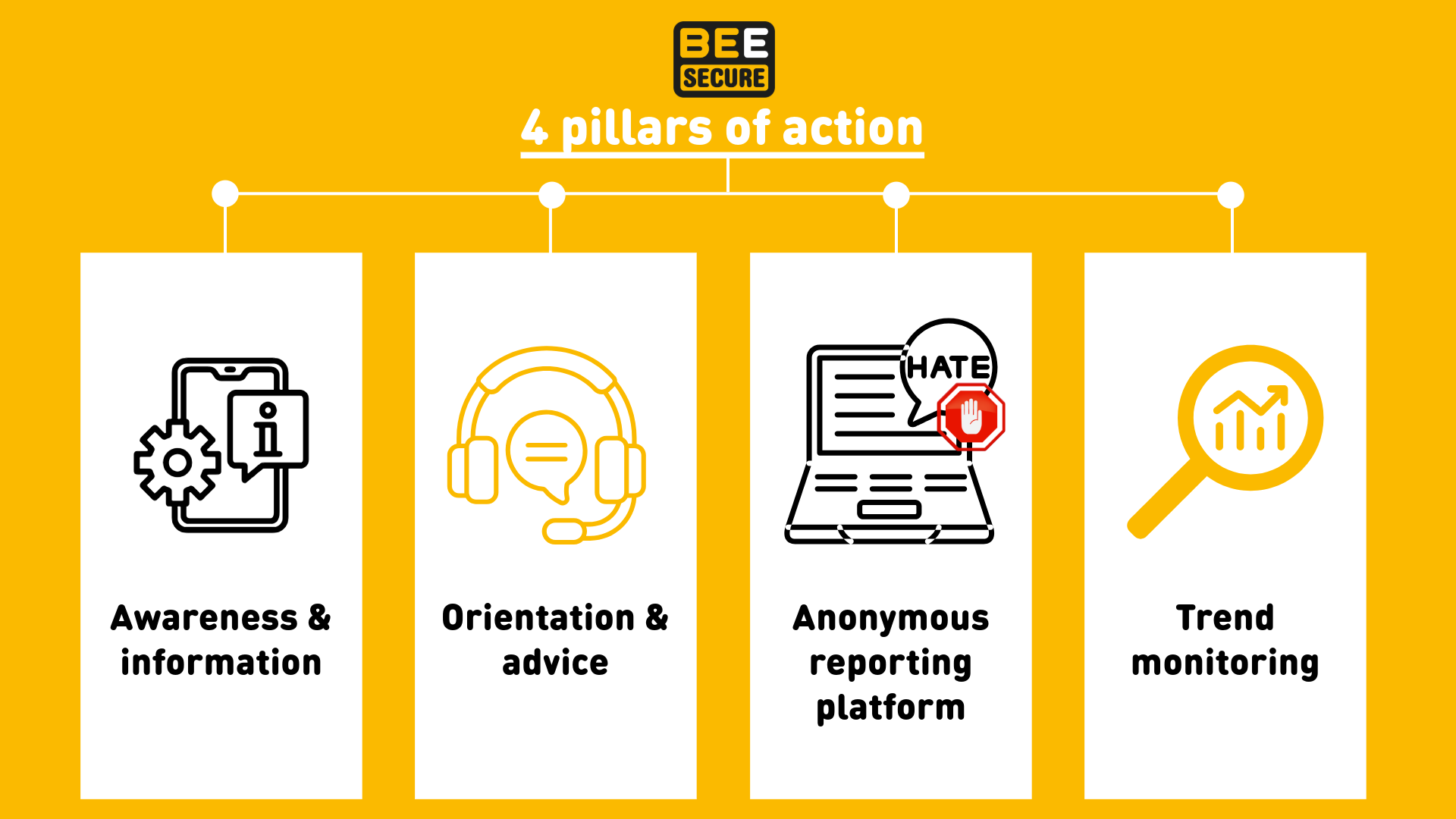
BEE SECURE acts in the following four areas:
- Awareness and information: BEE SECURE disseminates information and advice through various offers and activities. The focus is on awareness trainings. Like the multi-faceted publication offer, trainings cover a broad range of topics. The initiative also regularly launches thematic campaigns and events.
- Orientation and advice: The BEE SECURE Helpline is a counselling service. Anyone can consult the service for questions related to the internet and digital media safety by phone or contact form. The counselling via phone is anonymous and confidential.
- Anonymous reporting platform: The BEE SECURE Stopline is an online platform where three categories of potential illegal content can be reported anonymously: (1) Child sexual abuse material (CSAM), (2) discrimination, racism, revisionism or hate speech and (3) terrorism. Relevant content is forwarded to the national police or other competent authorities.
- Trend-Monitoring: BEE SECURE stays abreast of the latest online trends and developments in order to orient its actions. Observations in relation to the use of digital technology by children and young people made by the initiative during its activities in Luxembourg are published annually in the “BEE SECURE Radar” report.
The SIC supports the European Commission (EC) when it comes to monitor the impact of digitalisation on the mental and physical well-being of children. In this context, a major objective of the SIC is to act as a portal to the youth and their views and inform the EC on DSA-related insights, e.g. on how young people perceive online safety and risks. The SIC carries out decidated surveys, youth consultations and regularly reports its findings and further observations to the EC, contributing to early identification of trends.
The SIC also aims to be a reliable partner to the EC as enforcement body of relevant legislation in the field of child online safety, and particularly the Digital Services Act (DSA) which has the main goal to create a digital space that respects citizens and consumers’ fundamental rights and to enhance protection of minors online. As Luxembourg’s first national trusted flagger, BEE SECURE also plays a structural role in the national implementation of the DSA. The SIC further promotes the BIK+ strategy and related legislative frameworks, such as DSA, within its well-established multi-stakeholder national network and upholds a mature, continous working relationship with the national Digital Services Coordinator (DSC).
The SIC helps children, young people, parents, and teachers understand how the Digital Services Act (DSA) protects them online. Through creative projects, training sessions, campaigns and cooperation with national authorities, the SIC strives to bring the content and meaning of a complex legislative framework to a level where children and young people can see its benefits and purpose.
Awareness centre
BEE SECURE disseminates information and advice by systematically providing training sessions in primary and secondary schools (the BEE SECURE awareness training has been integrated into the school curriculum) and also by providing extracurricular training modules dedicated to children and young people, further training for teachers and educators, as well as information events for parents and carers. The initiative also provides publications and practical guides for children, youth and their entourage. BEE SECURE makes this information available to the general public through its websites, social networks and the national press.
Services offered:
Training for groups of children/young people:
- School classes: https://www.bee-secure.lu/fr/formations/classes-scolaires/
- Extra-curricular groups: https://www.bee-secure.lu/fr/formations/groupes-extra-scolaires/
- New activity for school classes & extra-curricular groups: https://www.bee-secure.lu/fr/escape-game/
Parent trainings: https://www.bee-secure.lu/fr/formations/parents/
Teachers/educators trainings: https://www.bee-secure.lu/fr/formations/personnel-enseignant-et-educatif/
Contact for training/event bookings & press: https://www.bee-secure.lu/fr/contact
Opening Hours:
Monday – Friday from 09:00 - 16:00
Helpline
The BEE SECURE Helpline is a counselling service. Anyone can consult the service with questions about internet and digital media safety. The counselling via phone (8002-1234) is free and confidential. Current main topics of advice seekers are e-crime, data privacy, media literacy, cyberbullying, sexting and sextortion.
Contact:
Phone number: 8002 1234 (only reachable within the Luxembourgish network)
BEE SECURE Helpline form: https://www.bee-secure.lu/fr/formulaire-contact-bee-secure-helpline/
Opening hours:
- Mondays, Tuesdays and Wednesdays from 09:00-16:00
- Thursdays from 15:00-18:00
- Fridays from 09:00-12:00
Hotline
The BEE SECURE Stopline is an online platform where three categories of potential illegal content can be reported anonymously:
- Child sexual abuse material (CSAM).
- Discrimination, racism, revisionism or hate speech.
- Terrorism.
Relevant content is forwarded to the national police or other competent authorities.
Contact and opening hours:
The BEE SECURE Stopline platform is open 24/7. Potential illegal content may be reported directly on the platform: https://stopline.bee-secure.lu/fr/
Youth participation
BEE SECURE places young people at the centre of its mission to create a safer and more empowering digital world. Through its Kids & Youth Consultations, children and adolescents are invited to share their daily digital experiences, concerns, and ideas. These sessions give young people an active role in shaping how digital-safety topics are addressed: they test educational material, provide feedback, and help define themes that matter to them.
Complementing this, the Digital Ambassadors Programme empowers motivated 14- to 18-year-olds to go even further. As Digital Ambassadors, young people collaborate with BEE SECURE on concrete projects, co-create content, discuss topics such as AI, privacy, and online well-being, and act as peer voices within their communities.
Together, both formats ensure that youth are not passive recipients of information but active partners in shaping the digital environment they grow up in.
Key successes
BEE SECURE was honoured to receive wide media coverage in 2025, with 63 interview requests and a total of 324 media mentions.
The total number of training sessions in 2025 was 1,211, reaching around 27,000 participants.
In 2025, BEE SECURE further developed its child and youth participation formats. The former Kids and Youth Panels concept was redesigned and broadened through new youth participation projects, including Kids and Youth Consultations and the Digital Ambassadors group.
To reach its target audiences as directly as possible, BEE SECURE organised and participated in a wide range of interactive events. In 2025, BEE SECURE took part in 55 events, including 8 organised directly by the initiative and 47 arranged by external partners.
A key success was the satirical video “Cornhub ≠ Reality”, launched as part of the Cyberjungle campaign. The video encouraged young people to develop a critical view of online pornography and to understand that pornographic content does not reflect reality. It reached 696,234 views across Meta and YouTube and won the award for Best Awareness-Raising Resource from the European network of Safer Internet Centres in October 2025.

Key partners/promoters
Key supporters are The Ministry of Education, Children and Youth, the Ministry of the Economy, the Ministry of Family Affairs, Integration and the Greater Region, Luxembourg House of Cybersecurity (LHC), the Luxembourg Police, the Public Prosecutor’s Office of the Grand Duchy of Luxembourg; the European Commission, Insafe, INHOPE.
Advisory Board members are:
- AFP-Solidarité-Famille a.s.b.l. Erzéiungs- a Familljeberodung
- ALIA - Autorité Luxembourgeoise Indépendante de l’Audiovisuel
- Agence Nationale pour l'Information des Jeunes
- ASTI - Association de Soutienaux Travailleurs Immigrés Luxembourg a.s.b.l.
- Autorité de la Concurrence – Ministère d’Économie
- CEC Luxembourg – Centre Européen des Consommateurs GIE
- CESAS - Centre national de référence pour la promtion de santé affective et sexuelle
- CET - Centre pour l'Egalité de Traitement
- CGJL - Conférence Générale de la Jeunesse du Luxembourg
- Chambre des Métiers Luxembourg
- CNAPA - Centre National de Prévention des Addictions
- CNPD - Commission Nationale pour la Protection des Données
- Conseil de Presse
- Dysphasie.lu a.s.b.l
- ECPAT Luxembourg
- Eltereschoul Janusz Korczak
- EwB - ErwuesseBildung
- FAPEL - Fédération des Association de Parents d'Eleves du Luxembourg
- Fondation RESTENA - Réseau Téléinformatique de l'Education Nationale et de la Recherche
- GoldenMe a.s.b.l.
- GOVCERT.LU
- Impuls - Service Thérapeutique Solidarité Jeunes
- KJT
- Level2
- LHC - Luxembourg House of Cybersecurity
- Ministère de l’Agriculture, de l’Alimentation et de la Viticulture - Direction de la protection des consommateurs
- Ministère de l'Economie
- Ministère de l’Éducation nationale, de l’Enfance et de la Jeunesse - SCRIPT - Service de Coordination de la Recherche et de l’Innovation pédagogiques et technologiques
- Ministère de l’Éducation nationale, de l’Enfance et de la Jeunesse Service développement Qualité des secteurs non-formels et aide à l’enfance –
- Ministère d’État - SMC - Service des médias, de la connectivité et de la politique numérique
- Ministère de la Famille, des Solidarités, du Vivre ensemble et de l’Accueil
- Ministère de la Santé
- NorTIC
- Observatoire national de l'enfance, de la jeunesse et de la qualité scolaire
- OKAJU - Ombudsman fir Kanner a JugendlecherParquet du Tribunal d'Arrondissement de Luxembourg
- Parquet du Tribunal d’Arrondissement de Luxembourg
- Police Grand-Ducale - Service Prévention
- Police Grand-Ducale - Service de Police Judiciaire – Cellule Anti-Terrorismus
- POST
- Respect.lu
- RTL
- Technolink
- ULC - Union Luxembourgeoise des Consommateurs Nouvelle a.s.b.l.
- Université de Luxembourg
- Université de Luxembourg - CISO
- Young Caritas
- ZEV - Zenter fir exzessiivt Verhalen a Verhalenssucht
- ZpB - Zentrum fir politesch Bildung

Additional links / resources
About the organisation
BEE SECURE is a governmental initiative of the Grand Duchy of Luxembourg, operated by the Service national de la jeunesse (SNJ) and the KJT, in partnership with Luxembourg House of Cybersecurity, the Luxembourg Police and the Public Prosecutor’s Office of the Grand Duchy of Luxembourg.
BEE SECURE is coordinated by the SNJ and co-financed by the European Commission.
Governmental involvement is provided by the Ministry of Education, Children and Youth and the Ministry of the Economy. BEE SECURE is part of the European networks Insafe (awareness-raising centres and helplines) and INHOPE (International Association of Internet Hotlines, reporting centres for illegal content).
The initiative’s mission:
BEE SECURE aims to raise awareness of a safety-oriented and responsible use of digital technology to the general public, and to particularly empower children, young people and their entourage (parents, teachers, educators) through targeted offers.
BEE SECURE acts in the following four areas:
- Awareness and information: BEE SECURE disseminates information and advice through various offers and activities. The focus is on awareness trainings. Like the multi-faceted publication offer, trainings cover a broad range of topics. The initiative also regularly launches thematic campaigns and events.
- Orientation and advice: The BEE SECURE Helpline is a counselling service. Anyone can consult the service for questions related to the internet and digital media safety by phone or contact form. The counselling via phone is anonymous and confidential.
- Anonymous reporting platform: The BEE SECURE Stopline is an online platform where three categories of potential illegal content can be reported anonymously: (1) Child sexual abuse material (CSAM), (2) discrimination, racism, revisionism or hate speech and (3) terrorism. Relevant content is forwarded to the national police or other competent authorities.
- Trend-Monitoring: BEE SECURE stays abreast of the latest online trends and developments in order to orient its actions. Observations in relation to the use of digital technology by children and young people made by the initiative during its activities in Luxembourg are published annually in the “BEE SECURE Radar” report.
The SIC supports the European Commission (EC) when it comes to monitor the impact of digitalisation on the mental and physical well-being of children. In this context, a major objective of the SIC is to act as a portal to the youth and their views and inform the EC on DSA-related insights, e.g. on how young people perceive online safety and risks. The SIC carries out decidated surveys, youth consultations and regularly reports its findings and further observations to the EC, contributing to early identification of trends.
The SIC also aims to be a reliable partner to the EC as enforcement body of relevant legislation in the field of child online safety, and particularly the Digital Services Act (DSA) which has the main goal to create a digital space that respects citizens and consumers’ fundamental rights and to enhance protection of minors online. As Luxembourg’s first national trusted flagger, BEE SECURE also plays a structural role in the national implementation of the DSA. The SIC further promotes the BIK+ strategy and related legislative frameworks, such as DSA, within its well-established multi-stakeholder national network and upholds a mature, continous working relationship with the national Digital Services Coordinator (DSC).
The SIC helps children, young people, parents, and teachers understand how the Digital Services Act (DSA) protects them online. Through creative projects, training sessions, campaigns and cooperation with national authorities, the SIC strives to bring the content and meaning of a complex legislative framework to a level where children and young people can see its benefits and purpose.
Awareness centre
BEE SECURE disseminates information and advice by systematically providing training sessions in primary and secondary schools (the BEE SECURE awareness training has been integrated into the school curriculum) and also by providing extracurricular training modules dedicated to children and young people, further training for teachers and educators, as well as information events for parents and carers. The initiative also provides publications and practical guides for children, youth and their entourage. BEE SECURE makes this information available to the general public through its websites, social networks and the national press.
Services offered:
Training for groups of children/young people:
- School classes: https://www.bee-secure.lu/fr/formations/classes-scolaires/
- Extra-curricular groups: https://www.bee-secure.lu/fr/formations/groupes-extra-scolaires/
- New activity for school classes & extra-curricular groups: https://www.bee-secure.lu/fr/escape-game/
Parent trainings: https://www.bee-secure.lu/fr/formations/parents/
Teachers/educators trainings: https://www.bee-secure.lu/fr/formations/personnel-enseignant-et-educatif/
Contact for training/event bookings & press: https://www.bee-secure.lu/fr/contact
Opening Hours:
Monday – Friday from 09:00 - 16:00
Helpline
The BEE SECURE Helpline is a counselling service. Anyone can consult the service with questions about internet and digital media safety. The counselling via phone (8002-1234) is free and confidential. Current main topics of advice seekers are e-crime, data privacy, media literacy, cyberbullying, sexting and sextortion.
Contact:
Phone number: 8002 1234 (only reachable within the Luxembourgish network)
BEE SECURE Helpline form: https://www.bee-secure.lu/fr/formulaire-contact-bee-secure-helpline/
Opening hours:
- Mondays, Tuesdays and Wednesdays from 09:00-16:00
- Thursdays from 15:00-18:00
- Fridays from 09:00-12:00
Hotline
The BEE SECURE Stopline is an online platform where three categories of potential illegal content can be reported anonymously:
- Child sexual abuse material (CSAM).
- Discrimination, racism, revisionism or hate speech.
- Terrorism.
Relevant content is forwarded to the national police or other competent authorities.
Contact and opening hours:
The BEE SECURE Stopline platform is open 24/7. Potential illegal content may be reported directly on the platform: https://stopline.bee-secure.lu/fr/
Youth participation
BEE SECURE places young people at the centre of its mission to create a safer and more empowering digital world. Through its Kids & Youth Consultations, children and adolescents are invited to share their daily digital experiences, concerns, and ideas. These sessions give young people an active role in shaping how digital-safety topics are addressed: they test educational material, provide feedback, and help define themes that matter to them.
Complementing this, the Digital Ambassadors Programme empowers motivated 14- to 18-year-olds to go even further. As Digital Ambassadors, young people collaborate with BEE SECURE on concrete projects, co-create content, discuss topics such as AI, privacy, and online well-being, and act as peer voices within their communities.
Together, both formats ensure that youth are not passive recipients of information but active partners in shaping the digital environment they grow up in.
Key successes
BEE SECURE was honoured to receive wide media coverage in 2025, with 63 interview requests and a total of 324 media mentions.
The total number of training sessions in 2025 was 1,211, reaching around 27,000 participants.
In 2025, BEE SECURE further developed its child and youth participation formats. The former Kids and Youth Panels concept was redesigned and broadened through new youth participation projects, including Kids and Youth Consultations and the Digital Ambassadors group.
To reach its target audiences as directly as possible, BEE SECURE organised and participated in a wide range of interactive events. In 2025, BEE SECURE took part in 55 events, including 8 organised directly by the initiative and 47 arranged by external partners.
A key success was the satirical video “Cornhub ≠ Reality”, launched as part of the Cyberjungle campaign. The video encouraged young people to develop a critical view of online pornography and to understand that pornographic content does not reflect reality. It reached 696,234 views across Meta and YouTube and won the award for Best Awareness-Raising Resource from the European network of Safer Internet Centres in October 2025.
Key partners/promoters
Key supporters are The Ministry of Education, Children and Youth, the Ministry of the Economy, the Ministry of Family Affairs, Integration and the Greater Region, Luxembourg House of Cybersecurity (LHC), the Luxembourg Police, the Public Prosecutor’s Office of the Grand Duchy of Luxembourg; the European Commission, Insafe, INHOPE.
Advisory Board members are:
- AFP-Solidarité-Famille a.s.b.l. Erzéiungs- a Familljeberodung
- ALIA - Autorité Luxembourgeoise Indépendante de l’Audiovisuel
- Agence Nationale pour l'Information des Jeunes
- ASTI - Association de Soutienaux Travailleurs Immigrés Luxembourg a.s.b.l.
- Autorité de la Concurrence – Ministère d’Économie
- CEC Luxembourg – Centre Européen des Consommateurs GIE
- CESAS - Centre national de référence pour la promtion de santé affective et sexuelle
- CET - Centre pour l'Egalité de Traitement
- CGJL - Conférence Générale de la Jeunesse du Luxembourg
- Chambre des Métiers Luxembourg
- CNAPA - Centre National de Prévention des Addictions
- CNPD - Commission Nationale pour la Protection des Données
- Conseil de Presse
- Dysphasie.lu a.s.b.l
- ECPAT Luxembourg
- Eltereschoul Janusz Korczak
- EwB - ErwuesseBildung
- FAPEL - Fédération des Association de Parents d'Eleves du Luxembourg
- Fondation RESTENA - Réseau Téléinformatique de l'Education Nationale et de la Recherche
- GoldenMe a.s.b.l.
- GOVCERT.LU
- Impuls - Service Thérapeutique Solidarité Jeunes
- KJT
- Level2
- LHC - Luxembourg House of Cybersecurity
- Ministère de l’Agriculture, de l’Alimentation et de la Viticulture - Direction de la protection des consommateurs
- Ministère de l'Economie
- Ministère de l’Éducation nationale, de l’Enfance et de la Jeunesse - SCRIPT - Service de Coordination de la Recherche et de l’Innovation pédagogiques et technologiques
- Ministère de l’Éducation nationale, de l’Enfance et de la Jeunesse Service développement Qualité des secteurs non-formels et aide à l’enfance –
- Ministère d’État - SMC - Service des médias, de la connectivité et de la politique numérique
- Ministère de la Famille, des Solidarités, du Vivre ensemble et de l’Accueil
- Ministère de la Santé
- NorTIC
- Observatoire national de l'enfance, de la jeunesse et de la qualité scolaire
- OKAJU - Ombudsman fir Kanner a JugendlecherParquet du Tribunal d'Arrondissement de Luxembourg
- Parquet du Tribunal d’Arrondissement de Luxembourg
- Police Grand-Ducale - Service Prévention
- Police Grand-Ducale - Service de Police Judiciaire – Cellule Anti-Terrorismus
- POST
- Respect.lu
- RTL
- Technolink
- ULC - Union Luxembourgeoise des Consommateurs Nouvelle a.s.b.l.
- Université de Luxembourg
- Université de Luxembourg - CISO
- Young Caritas
- ZEV - Zenter fir exzessiivt Verhalen a Verhalenssucht
- ZpB - Zentrum fir politesch Bildung
Additional links / resources
- < Previous country profile
- Next country profile >
- < Previous country
- Next country >
Related news and resources


