

Before working through this deep dive, why not take this short quiz to see how much you already know about cyberbullying?
Technology can empower people to connect, enjoy and learn in a positive and safe way. Sadly, not all behaviour is positive online and cyberbullying is a problem that has existed for many years.
This module will explore what cyberbullying is, how it happens and what you need to know about it to support your child.
Activity
Before starting this training module, take a moment to think about how you would define cyberbullying.
Cyberbullying is...
If you have opportunity, ask your child what they think cyberbullying is. Does their definition match yours? Talking about what cyberbullying is can be a great way to start a conversation about how to tackle bullying online.
What is cyberbullying?
"Cyberbullying refers to intentional and repeated harm that others inflict via a digital device”
(Hinduja and Patchin, 2009).
The above definition of cyberbullying is just one of many that experts and researchers have put forward, but the wide nature of cyberbullying has made it difficult to define accurately. The European Commission is working to prepare a common definition of cyberbullying to help countries across the EU define and fight cyberbullying.
However, many researchers and policymakers agree that cyberbullying can include the following:
- intention (bullying on purpose)
- repetition (repeating the same behaviours to bully)
- a power imbalance (the bully/bullies have more power than the target)
- sense of anonymity (the victim cannot identify the bully)
- use of electronic/digital technology
- a lack of accountability (believing that actions do not have consequences)
- publicity (making the bullying public for others to see)
- direct cyberbullying (for example, offensive messages sent directly to another person online)
- indirect cyberbullying (the target isn’t aware of the bullying behaviour)
What forms can cyberbullying take?
The use of technology and online tools/services means cyberbullying can include any of the following forms:
- Text - (such as threatening or offensive comments, social media posts, website content or messages)
- Visual – images or videos (such as embarrassing or compromising images of a person, fake or manipulated images/videos, visual content designed to fear/shock/upset, and memes designed to mock or offend)
- Audio - (such as threatening voice messages or phone calls, offensive in-game audio chat, or other audio designed to intimidate, offend or upset)
- Behaviours that mirror offline violence (such as behaviour where a user may repeatedly invade the ‘physical space’ of another or repeatedly target and attack them in a game or VR experience)
- Public communication (bullying behaviour visible to other online users)
- Private communication (bullying behaviour visible only to the victim(s))
Pozza et al. (2016) outlined a number of different behaviours that could be considered as forms of cyberbullying. These include ‘exclusion’ (deliberating leaving someone out of an online group or chat), ‘griefing’ (harassing someone in an online game or virtual world), ‘cyberstalking’ (sending continuous threats and offensive messages to one person across different apps/games) and ‘outing’ (sharing someone’s personal or private information publicly without their permission).
As you can see, there is a wide range of behaviours that can be considered to be cyberbullying. Helping your child to become aware of these different types can help them spot when someone is behaving this way online – this can help your child protect themselves, but also protect other users by reporting unacceptable behaviour whenever they witness it.
How common is cyberbullying?
Cyberbullying (and bullying in general) is not new, but it is sadly a persistent risk that can be faced by anyone online.
Research studies report a wide range of levels of cyberbullying across different countries and ages. A review of cyberbullying studies in EU countries in 2022 found the following:
- Cybervictimisation – young people reporting being a victim of cyberbullying ranged from 3%-31%
- Cyberperpetration – young people reporting they have bullied others ranged from 3%-30%
- Cyberbystander – young people reporting they had seen cyberbullying happening to others ranged from 13%-53%
Although figures vary from study to study, all research and statistics point to cyberbullying as a serious issue that can affect children and young people.
The Insafe network of Safer Internet Centres operate helplines for educators, youth and parents/carers to seek help and advice with online safety concerns. In 2024, 14% of contacts with the Safer Internet Centres helplines were about cyberbullying issues. Figure 1 shows an example of the different reasons for contacting the helplines over a three-month period.
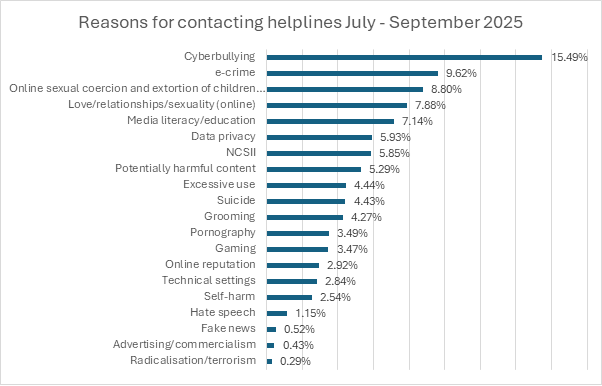
Table description: Among the most common reasons for contacting helplines between July and September 2025 were cyberbullying, e-crime, and online sexual coercion and child extortion. Followed by, in descending order, love/relationships/sexuality (online), media literacy/education, data privacy, NCSII (non-consensual sharing of intimate images), potentially harmful content, excessive use, suicide, grooming, pornography, gaming, online reputation, technical settings, self-harm, hate speech, fake news, advertising/commercialism, radicalisation/terrorism.
Since 2019, cyberbullying has consistently been the most common reason for contacting the helplines in every quarterly review of reasons for contact.
Why do people cyberbully?
There are a number of different reasons as to why someone may choose to bully someone else online.
These include:
- An extension of offline bullying – shifting the behaviour online allows a bully to target someone at any time of day or night, and from any location. It also allows them to abuse or harass someone multiple times very quickly, either through one app or platform or across multiple online platforms.
- Seeking ‘revenge’ on someone who they believed has wronged them.
- Treating someone else badly in order to make the bully feel ‘better’ about themselves.
- Displacement – some bullies are the victim of bullying themselves and seek to displace their feelings about their own abuse by targeting someone else with the same behaviour.
- Perceiving bullying to be ‘fun’ or a game; being online (and sometimes anonymous) can lead people to see cyberbullying behaviour as ‘not real’
- A lack of understanding of morals, emotions and empathy.
- Joining in with the bullying behaviour by others in order to conform to social norms or ‘fit in’.
- An attempt to get attention from other users.
- A targeted attack on an individual or a group driven by dislike or hatred for personal characteristics (such as race, gender, sexual orientation, etc.). In these cases, bullying would also be considered hate speech and (if inciting violence) possibly a hate crime. The EU Action plan against cyberbullying provides a specific focus on groups, such as LGBTIQ and migrants, that may be vulnerable to this type of bullying.
How can cyberbullying affect my child?
Cyberbullying can be very upsetting, worrying and overwhelming to a child. There are no guaranteed signs that show your child is being cyberbullied, but there are things you can look out for that might suggest that your child is worried or upset.
These include changes in mood (such as angry outbursts), low self-esteem, disrupted sleep, changes in eating, withdrawing from online/offline activities, or negative behaviour towards others. For some young people, cyberbullying can lead to depression and self-harm.
Everyone is affected differently by their experiences, so a child being bullied might not display all or any of the above. These signs might also be caused by something other than cyberbullying. However, if you notice any changes in your child's behaviour, it is important to talk to them about how they are feeling and any worries they might have, and then take action to resolve the issue.
What can I do as a parent/carer?
If your child experiences cyberbullying, it is important to take steps to support them. The following tips can help you:
- Don’t deny access to tech – if a child is being bullied, it can be tempting to take away their technology so a bully can’t continue to abuse them. However, this often leads to children feeling even more upset – the technology they love using has been take off them due to the bad behaviour of someone else! Removing technology may provide short-term relief from bullying, but it also doesn’t tackle the root cause of the problem.
- Discuss cyberbullying – take the time to regularly discuss online behaviour with your child – what is acceptable? What is unacceptable? Discussing what might happen provides chances to develop plans for how to tackle issues before they happen.
- Consider behaviour – keep in mind the possibility that your child could be a perpetrator of cyberbullying, not just a victim. The World Health Organisation found that one in eight European children had admitted to cyberbullying others, with boys (14%) more likely than girls (9%). Seek advice from your child’s school, your national Safer Internet Centre or health professionals if you are concerned about your child’s behaviour online towards others.
- Don’t ignore it – cyberbullying is a real issue that can have a negative impact on your child. Working with them to tackle the problem is important.
- Find and use online reporting tools – work with your child to find reporting and safety tools on their favourite apps and games. These can include block buttons, report buttons, privacy settings and other features that can empower them to get help for themselves or others.
- Understand the law – in your country, there may be laws that relate to cyberbullying. Only half of the EU Member States have defined cyberbullying in their national legislation. So, your country may have specific laws on bullying/cyberbullying, or other laws related to behaviours such as harassment or stalking.
- Know where to get help – if your child is involved in cyberbullying with other children from their school, seek support from the school. You can reach out to your national Safer Internet Centre for advice and support with cyberbullying issues involving young people. If you feel that the cyberbullying is breaking the law, you can also seek support from local law enforcement.
What advice should I give my child about cyberbullying?
Talking to your child regularly about online behaviour, as well as what to do when they experience (or see others experiencing) cyberbullying, is crucial to empowering them to seek help.
The following is useful advice for your child about what to do if they or someone they know is being cyberbullied:
- Tell someone – reaching out to a trusted adult (such as a parent/carer or teacher) is crucial to ensure that a young person gets the help and support they need to tackle a cyberbullying issue. In many European countries, young people can also ring 116 111 to receive support from a helpline.
- Show respect and kindness online – showing positive and respectful behaviour in games and on social media can help protect a young person from being bullied, as well as encourage other people to behave positively.
- Don’t retaliate – it can be tempting for children and young people to treat a bully in the same way that they are being treated – to be abusive and hurtful back. However, this usually makes the situation worse and can lead to them also being labelled as a bully when they were acting in self-defence.
- Save the evidence – using screenshot and video capture tools to save proof of a bully’s actions is an important step. This can ensure that evidence can be passed to a trusted adult, law enforcement (if laws have been broken) and online services in order to take action against a bully’s behaviour.
- Use online tools – tools such as blocking can prevent a bully from contacting your child, and report buttons can alert a game/app that someone is behaving in a way that breaks their rules. Privacy settings can empower your child to control who sees their personal information and who can contact them.
Further information and resources
Want to learn more about cyberbullying? You may find these resources interesting:


Explore related deep dive articles


Before working through this deep dive, why not take this short quiz to see how much you already know about cyberbullying?
Technology can empower people to connect, enjoy and learn in a positive and safe way. Sadly, not all behaviour is positive online and cyberbullying is a problem that has existed for many years.
This module will explore what cyberbullying is, how it happens and what you need to know about it to support your child.
Activity
Before starting this training module, take a moment to think about how you would define cyberbullying.
Cyberbullying is...
If you have opportunity, ask your child what they think cyberbullying is. Does their definition match yours? Talking about what cyberbullying is can be a great way to start a conversation about how to tackle bullying online.
What is cyberbullying?
"Cyberbullying refers to intentional and repeated harm that others inflict via a digital device”
(Hinduja and Patchin, 2009).
The above definition of cyberbullying is just one of many that experts and researchers have put forward, but the wide nature of cyberbullying has made it difficult to define accurately. The European Commission is working to prepare a common definition of cyberbullying to help countries across the EU define and fight cyberbullying.
However, many researchers and policymakers agree that cyberbullying can include the following:
- intention (bullying on purpose)
- repetition (repeating the same behaviours to bully)
- a power imbalance (the bully/bullies have more power than the target)
- sense of anonymity (the victim cannot identify the bully)
- use of electronic/digital technology
- a lack of accountability (believing that actions do not have consequences)
- publicity (making the bullying public for others to see)
- direct cyberbullying (for example, offensive messages sent directly to another person online)
- indirect cyberbullying (the target isn’t aware of the bullying behaviour)
What forms can cyberbullying take?
The use of technology and online tools/services means cyberbullying can include any of the following forms:
- Text - (such as threatening or offensive comments, social media posts, website content or messages)
- Visual – images or videos (such as embarrassing or compromising images of a person, fake or manipulated images/videos, visual content designed to fear/shock/upset, and memes designed to mock or offend)
- Audio - (such as threatening voice messages or phone calls, offensive in-game audio chat, or other audio designed to intimidate, offend or upset)
- Behaviours that mirror offline violence (such as behaviour where a user may repeatedly invade the ‘physical space’ of another or repeatedly target and attack them in a game or VR experience)
- Public communication (bullying behaviour visible to other online users)
- Private communication (bullying behaviour visible only to the victim(s))
Pozza et al. (2016) outlined a number of different behaviours that could be considered as forms of cyberbullying. These include ‘exclusion’ (deliberating leaving someone out of an online group or chat), ‘griefing’ (harassing someone in an online game or virtual world), ‘cyberstalking’ (sending continuous threats and offensive messages to one person across different apps/games) and ‘outing’ (sharing someone’s personal or private information publicly without their permission).
As you can see, there is a wide range of behaviours that can be considered to be cyberbullying. Helping your child to become aware of these different types can help them spot when someone is behaving this way online – this can help your child protect themselves, but also protect other users by reporting unacceptable behaviour whenever they witness it.
How common is cyberbullying?
Cyberbullying (and bullying in general) is not new, but it is sadly a persistent risk that can be faced by anyone online.
Research studies report a wide range of levels of cyberbullying across different countries and ages. A review of cyberbullying studies in EU countries in 2022 found the following:
- Cybervictimisation – young people reporting being a victim of cyberbullying ranged from 3%-31%
- Cyberperpetration – young people reporting they have bullied others ranged from 3%-30%
- Cyberbystander – young people reporting they had seen cyberbullying happening to others ranged from 13%-53%
Although figures vary from study to study, all research and statistics point to cyberbullying as a serious issue that can affect children and young people.
The Insafe network of Safer Internet Centres operate helplines for educators, youth and parents/carers to seek help and advice with online safety concerns. In 2024, 14% of contacts with the Safer Internet Centres helplines were about cyberbullying issues. Figure 1 shows an example of the different reasons for contacting the helplines over a three-month period.
Table description: Among the most common reasons for contacting helplines between July and September 2025 were cyberbullying, e-crime, and online sexual coercion and child extortion. Followed by, in descending order, love/relationships/sexuality (online), media literacy/education, data privacy, NCSII (non-consensual sharing of intimate images), potentially harmful content, excessive use, suicide, grooming, pornography, gaming, online reputation, technical settings, self-harm, hate speech, fake news, advertising/commercialism, radicalisation/terrorism.
Since 2019, cyberbullying has consistently been the most common reason for contacting the helplines in every quarterly review of reasons for contact.
Why do people cyberbully?
There are a number of different reasons as to why someone may choose to bully someone else online.
These include:
- An extension of offline bullying – shifting the behaviour online allows a bully to target someone at any time of day or night, and from any location. It also allows them to abuse or harass someone multiple times very quickly, either through one app or platform or across multiple online platforms.
- Seeking ‘revenge’ on someone who they believed has wronged them.
- Treating someone else badly in order to make the bully feel ‘better’ about themselves.
- Displacement – some bullies are the victim of bullying themselves and seek to displace their feelings about their own abuse by targeting someone else with the same behaviour.
- Perceiving bullying to be ‘fun’ or a game; being online (and sometimes anonymous) can lead people to see cyberbullying behaviour as ‘not real’
- A lack of understanding of morals, emotions and empathy.
- Joining in with the bullying behaviour by others in order to conform to social norms or ‘fit in’.
- An attempt to get attention from other users.
- A targeted attack on an individual or a group driven by dislike or hatred for personal characteristics (such as race, gender, sexual orientation, etc.). In these cases, bullying would also be considered hate speech and (if inciting violence) possibly a hate crime. The EU Action plan against cyberbullying provides a specific focus on groups, such as LGBTIQ and migrants, that may be vulnerable to this type of bullying.
How can cyberbullying affect my child?
Cyberbullying can be very upsetting, worrying and overwhelming to a child. There are no guaranteed signs that show your child is being cyberbullied, but there are things you can look out for that might suggest that your child is worried or upset.
These include changes in mood (such as angry outbursts), low self-esteem, disrupted sleep, changes in eating, withdrawing from online/offline activities, or negative behaviour towards others. For some young people, cyberbullying can lead to depression and self-harm.
Everyone is affected differently by their experiences, so a child being bullied might not display all or any of the above. These signs might also be caused by something other than cyberbullying. However, if you notice any changes in your child's behaviour, it is important to talk to them about how they are feeling and any worries they might have, and then take action to resolve the issue.
What can I do as a parent/carer?
If your child experiences cyberbullying, it is important to take steps to support them. The following tips can help you:
- Don’t deny access to tech – if a child is being bullied, it can be tempting to take away their technology so a bully can’t continue to abuse them. However, this often leads to children feeling even more upset – the technology they love using has been take off them due to the bad behaviour of someone else! Removing technology may provide short-term relief from bullying, but it also doesn’t tackle the root cause of the problem.
- Discuss cyberbullying – take the time to regularly discuss online behaviour with your child – what is acceptable? What is unacceptable? Discussing what might happen provides chances to develop plans for how to tackle issues before they happen.
- Consider behaviour – keep in mind the possibility that your child could be a perpetrator of cyberbullying, not just a victim. The World Health Organisation found that one in eight European children had admitted to cyberbullying others, with boys (14%) more likely than girls (9%). Seek advice from your child’s school, your national Safer Internet Centre or health professionals if you are concerned about your child’s behaviour online towards others.
- Don’t ignore it – cyberbullying is a real issue that can have a negative impact on your child. Working with them to tackle the problem is important.
- Find and use online reporting tools – work with your child to find reporting and safety tools on their favourite apps and games. These can include block buttons, report buttons, privacy settings and other features that can empower them to get help for themselves or others.
- Understand the law – in your country, there may be laws that relate to cyberbullying. Only half of the EU Member States have defined cyberbullying in their national legislation. So, your country may have specific laws on bullying/cyberbullying, or other laws related to behaviours such as harassment or stalking.
- Know where to get help – if your child is involved in cyberbullying with other children from their school, seek support from the school. You can reach out to your national Safer Internet Centre for advice and support with cyberbullying issues involving young people. If you feel that the cyberbullying is breaking the law, you can also seek support from local law enforcement.
What advice should I give my child about cyberbullying?
Talking to your child regularly about online behaviour, as well as what to do when they experience (or see others experiencing) cyberbullying, is crucial to empowering them to seek help.
The following is useful advice for your child about what to do if they or someone they know is being cyberbullied:
- Tell someone – reaching out to a trusted adult (such as a parent/carer or teacher) is crucial to ensure that a young person gets the help and support they need to tackle a cyberbullying issue. In many European countries, young people can also ring 116 111 to receive support from a helpline.
- Show respect and kindness online – showing positive and respectful behaviour in games and on social media can help protect a young person from being bullied, as well as encourage other people to behave positively.
- Don’t retaliate – it can be tempting for children and young people to treat a bully in the same way that they are being treated – to be abusive and hurtful back. However, this usually makes the situation worse and can lead to them also being labelled as a bully when they were acting in self-defence.
- Save the evidence – using screenshot and video capture tools to save proof of a bully’s actions is an important step. This can ensure that evidence can be passed to a trusted adult, law enforcement (if laws have been broken) and online services in order to take action against a bully’s behaviour.
- Use online tools – tools such as blocking can prevent a bully from contacting your child, and report buttons can alert a game/app that someone is behaving in a way that breaks their rules. Privacy settings can empower your child to control who sees their personal information and who can contact them.
Further information and resources
Want to learn more about cyberbullying? You may find these resources interesting:
Explore related deep dive articles

