
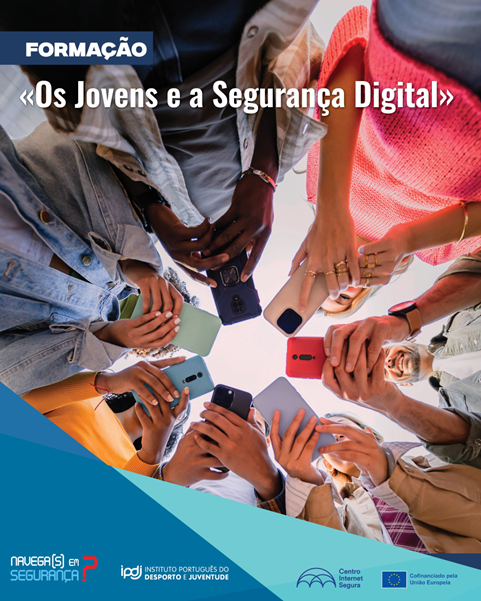
The Portuguese Institute of Sport and Youth (IPDJ) hosted the training session "Young people and digital security" for young volunteers and youth workers to explore the relationship between young people and the digital environment, with a particular focus on security, risks, and online rights.

As a partner of the Portuguese Safer Internet Centre, IPDJ delivered another edition of the online national training "Young people and digital security" on 17-25 November 2025, continuing the work already developed in this area. This was the third session offered in 2025.
The training targeted:
- young volunteers (priority group) and staff from the “Navegas em Segurança?” programme;
- youth workers who work with and for young people;
- youth workers coordinating “Navegas em Segurança?” projects promoted by youth associations and other NGOs implementing volunteer projects under the same programme.
The sessions were facilitated by experts from Lusófona University specialising in media literacy, digital citizenship, and the relationship between young people and digital environments.
The key topics addressed included:
- patterns of digital consumption
- categories of online risks
- social media: interactions, ethics, netiquette, and digital reputation
- online misconduct, content, and behaviours: online violence, cyberbullying, sexting, grooming, coercion and online sexual extortion, self-harm content, body shaming
- digital rights and digital citizenship
- participation and multi/inter culturalism
- hate speech
- disinformation: types of information disorders (identification and counteraction)
- “my phone listens to me”,algorithms
- cybersecurity: devices, privacy and security, access, cookies, and associated risks
- characteristics of influencer marketing
- gaming
- digital mediation
- healthy management of online behaviour and screen time (design and reward mechanisms).
A total of 21 volunteers from the “Navegas em Segurança?” programme took part in this online edition. Across the three training sessions delivered this year, around 50 volunteers and youth workers participated. Feedback from all editions was overwhelmingly positive.
Over the coming months, these volunteers will deliver peer-to-peer information sessions in elementary and secondary schools across the country, using non-formal education methods.
Find more information about the work of the Portuguese Safer Internet Centre, including its awareness raising, helpline, hotline, and youth participation services, or find similar information for other Safer Internet Centres throughout Europe.


The Portuguese Institute of Sport and Youth (IPDJ) hosted the training session "Young people and digital security" for young volunteers and youth workers to explore the relationship between young people and the digital environment, with a particular focus on security, risks, and online rights.
As a partner of the Portuguese Safer Internet Centre, IPDJ delivered another edition of the online national training "Young people and digital security" on 17-25 November 2025, continuing the work already developed in this area. This was the third session offered in 2025.
The training targeted:
- young volunteers (priority group) and staff from the “Navegas em Segurança?” programme;
- youth workers who work with and for young people;
- youth workers coordinating “Navegas em Segurança?” projects promoted by youth associations and other NGOs implementing volunteer projects under the same programme.
The sessions were facilitated by experts from Lusófona University specialising in media literacy, digital citizenship, and the relationship between young people and digital environments.
The key topics addressed included:
- patterns of digital consumption
- categories of online risks
- social media: interactions, ethics, netiquette, and digital reputation
- online misconduct, content, and behaviours: online violence, cyberbullying, sexting, grooming, coercion and online sexual extortion, self-harm content, body shaming
- digital rights and digital citizenship
- participation and multi/inter culturalism
- hate speech
- disinformation: types of information disorders (identification and counteraction)
- “my phone listens to me”,algorithms
- cybersecurity: devices, privacy and security, access, cookies, and associated risks
- characteristics of influencer marketing
- gaming
- digital mediation
- healthy management of online behaviour and screen time (design and reward mechanisms).
A total of 21 volunteers from the “Navegas em Segurança?” programme took part in this online edition. Across the three training sessions delivered this year, around 50 volunteers and youth workers participated. Feedback from all editions was overwhelmingly positive.
Over the coming months, these volunteers will deliver peer-to-peer information sessions in elementary and secondary schools across the country, using non-formal education methods.
Find more information about the work of the Portuguese Safer Internet Centre, including its awareness raising, helpline, hotline, and youth participation services, or find similar information for other Safer Internet Centres throughout Europe.
- digital citizenship education Teacher Training
Related content
- < Previous article
- Next article >
- < Previous
- Next >
Related articles


