

SID celebrations in the Netherlands focused on the theme “Harmful but lawful content”, as the Dutch Safer Internet Centre increasingly sees how content and behaviour that sit in the grey area, not necessarily illegal, but harmful, go unaddressed, despite posing real risks to children and young people.

On 10 February 2026, the Dutch Safer Internet Centre (Offlimits, ECP, and Netwerk Mediawijsheid) organised a national-wide stakeholder conference, in cooperation with UNICEF Nederland, MIND Us and the Municipality of Amsterdam. The conference focused on the theme “Harmful but lawful content”, as the Dutch Safer Internet Centre increasingly notices how certain content and behaviour sitting in a grey area - not necessarily illegal, but still harmful - often go unaddressed, despite posing real risks to children and young people.
The day was opened by alderman Alexander Scholtes (municipality of Amsterdam), Robbert Hoving (Offlimits) and Marjolijn Bonthuis (ECP), who reflected on 20 years of the Safer Internet Centre and the continuing urgency of the theme: a safer internet for children and young people. It is clear that steps have been taken in legislations both in the Netherlands and at the EU-level, and awareness of online safety has risen, but the complexity of the online landscape is still growing, partly due to algorithms and artificial intelligence (AI).
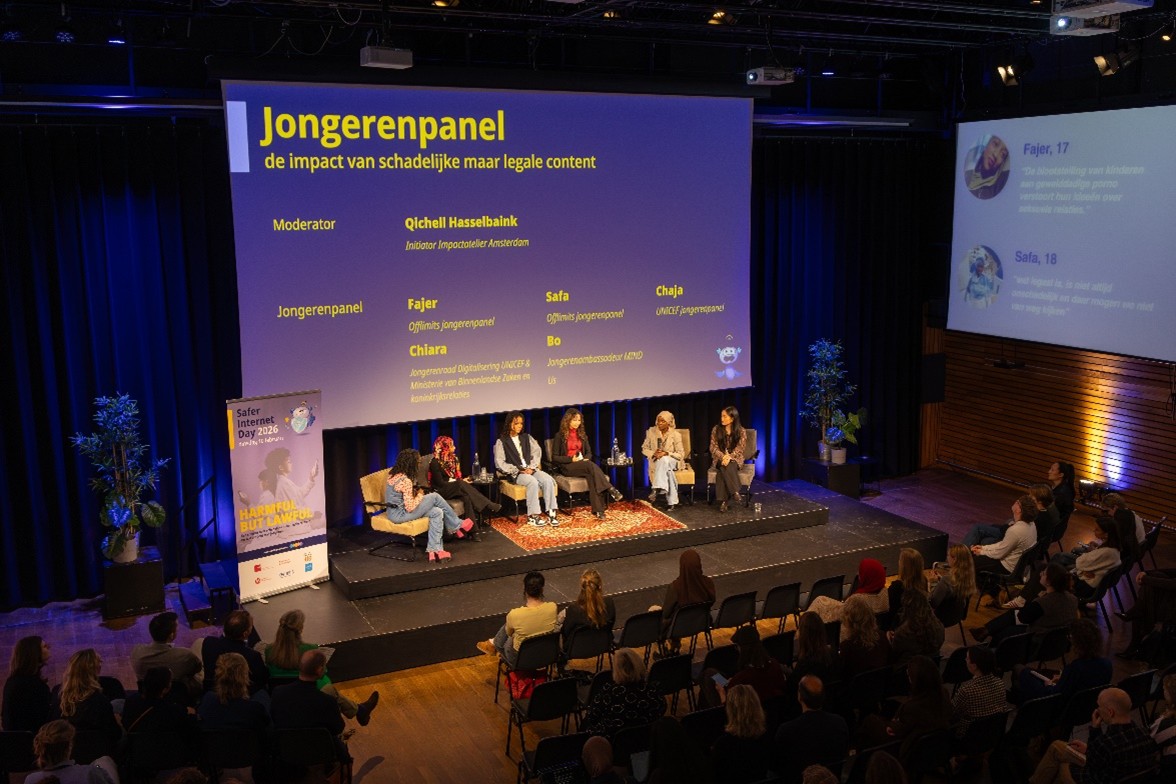
This was followed by an impactful session by the youth panel of MIND Us, UNICEF and Offlimits, moderated by Qishell Hasselbaink (JARA), during which young people spoke openly about their experiences online, including constant social comparison, pressure to perform and the normalisation of online hate. Their message was nuanced: social media offers connection and recognition, but at the same time can cause damage.
Mariëtte van Huijstee (Rathenau Institute) then explained the different typologies of harmful but lawful content, paired with Offlimits helpline cases to provide attendees a clearer picture of the issue that was being discussed on the day.
A thought-provoking panel session on online-identity based violence followed, moderated by Marjolijn Bonthuis and joined by Mariëtte van Huijstee, Nienke s'Gravemade (writer and manosphere expert) and Tomas Geling (COC Netherlands). The panelists discussed how this type of violence not only affects individuals, but puts entire communities under pressure. They also mentioned how algorithms amplify extreme and polarising content and how harmful trends, such as misogyny within the so-called manosphere, can take young people further step by step.
The morning ended with a break-out session, where three parallel sessions took place. Francien Dechesne (Leiden University) talked about the legal and ethical nature of harmful but lawful content, exploring how new technology such as AI and social media interact with the world, and the concept of new technology as a social experiment. Joran de Jong (municipality of Amsterdam) talked about the correlation between online and offline violence, and a youth-led session by PRAATPOWER brainstormed with participants on feasible actions for a healthier online environment.
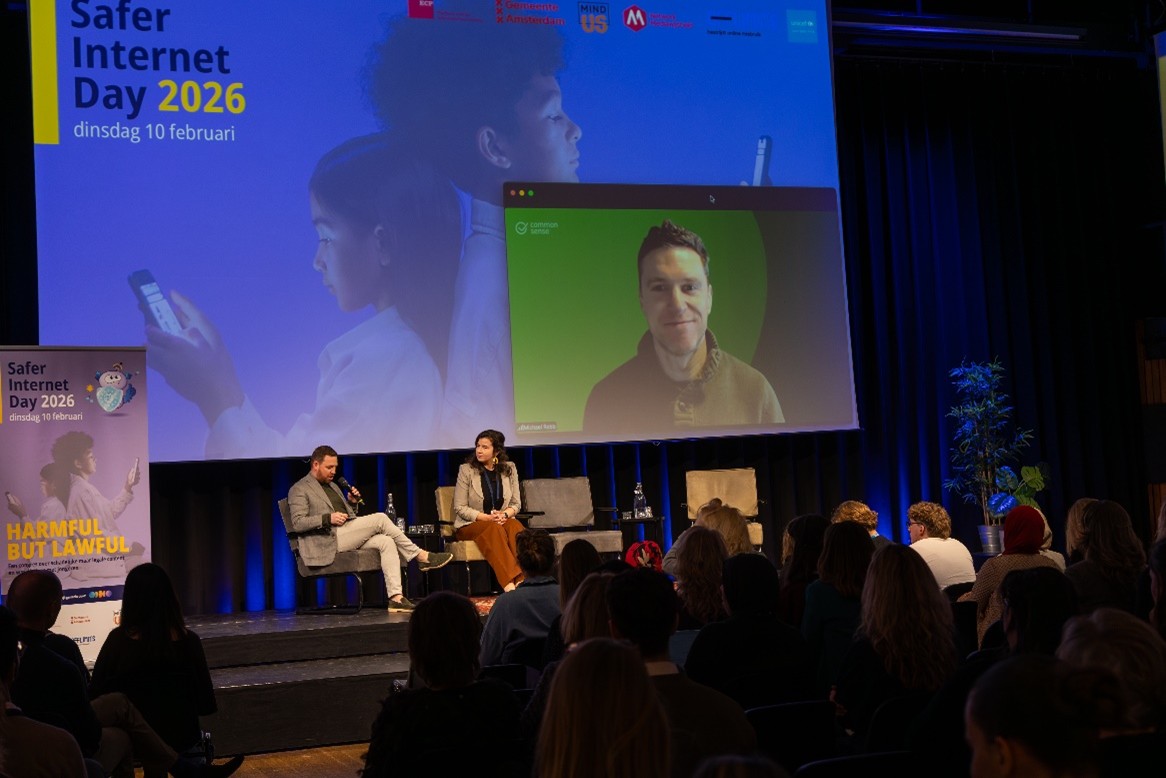
The afternoon started with technology philosopher, Wietse Hage, reflecting on the broader impact of AI as a fundamental system technology. AI influences how information is created, distributed, and trusted. In an age where images, voices and texts are easy to generate, our understanding of truth is under pressure.
This was followed by a panel session with Marthe Goudsmit Samaritter (Max Planck Institute) and Michael Robb (Common Sense Media), moderated by Dave Maasland (ESET Nederland), focusing on forged imagery (deepfake) and companion technology. Marthe talked about the complexity of forged imagery and why there should be no difference in terms of legislation when addressing generated and non-generated image-based abuse. Michael shared the concerning high number of children using companion technology.
It was clear from the speakers that these AI applications have raised new ethical and legal questions, and as much as we try to catch up, legislation often lags behind technological developments.
Following the AI session, a panel by Maartje de Bruin (Mensrijk Psychology Practice), Loïs Gampierakis (School & Safety Foundation) and youth panelists went on to explore the impact on the mental health and wellbeing of young people by new technologies, in particular AI. The young people pointed out how a digital detox contributes to a more peaceful and more productive lifestyle in the long term.
A second break-out session took place in the afternoon. Maike Borst (Dutch Police), Hendrik-Jan Overmeer (VGFN) and Ouassima Belmoussi (researcher and gamer) explored the toxicity in online gaming. Foundation Door Het Geluid focused on social media, and showed how reality is often not shown on social media.
Wouter Nieuwenhuizen (Rathenau Institute) and Leonore Snoek (municipality Amsterdam) demonstrated some redesign ideas of online environments, showing how digital platforms could be design to be more inclusive for all groups of people.
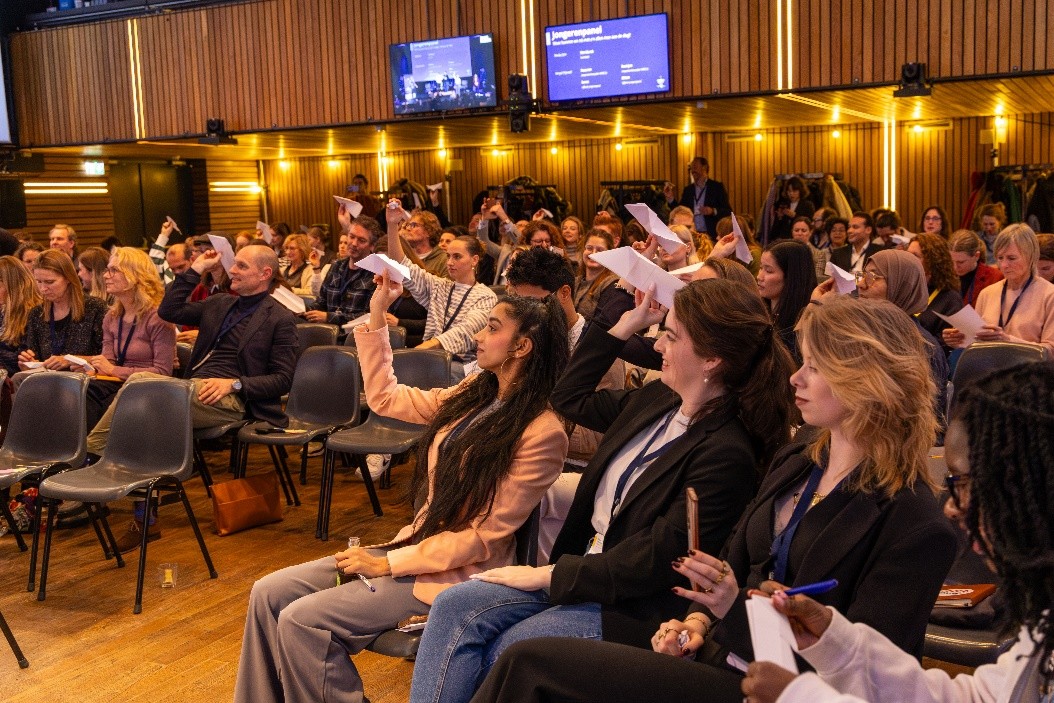
The whole day ended with a final youth panel, led by Tim Murck (Hackshield) and youth panelists.
The audience was challenged to write down what they want to see in the online world for the next generation. Wishes such as more self-confidence, less pressure to perform, technology that strengthens children's rights and freedom from addictive algorithms flew in paper airplanes towards the stage. The moment underlined that responsibility lies with everyone, and that young people themselves have an essential voice in shaping solutions.
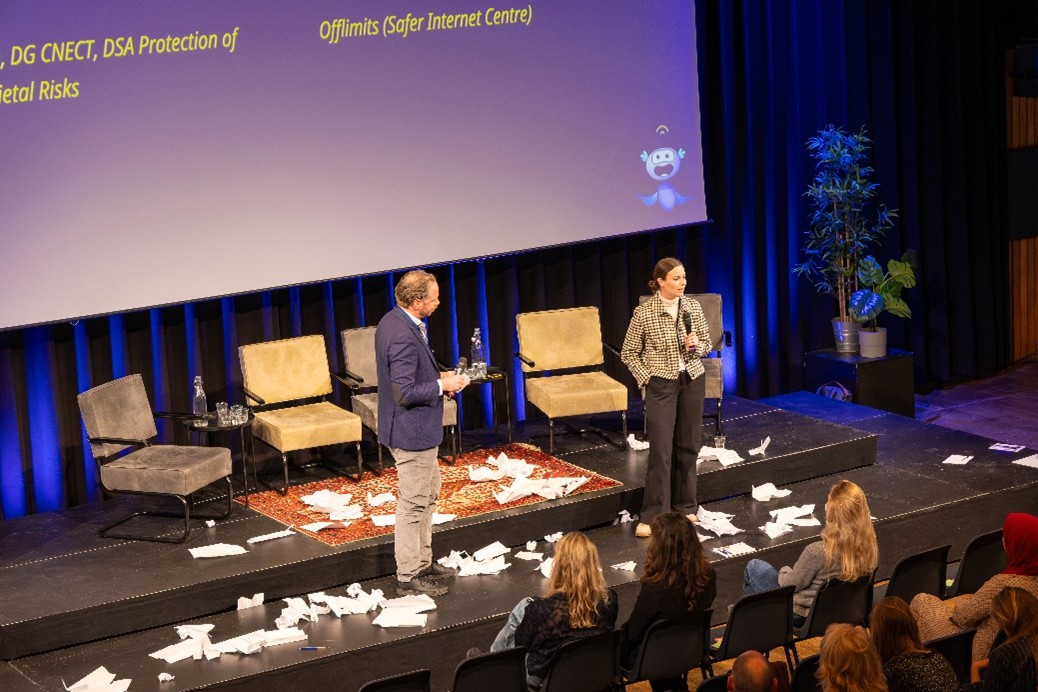
The closing by Julia van Best (European Commission) and Robbert Hoving fitted in seamlessly with this. By investing in values, self-confidence, and conscious online behaviour, in addition to designing actionable policies and enforcing them accordingly, the digital world can become safer, more positive, and more humane for the next generation.
The conference was attended by more than 200 experts from policymaking, academia, civil society, industry and more. At the end of the day, Safer Internet Day 2026 made it clear: the future of the internet requires not only rules and technology, but joint responsibility and taking the voice of young people seriously.
Learn more about the Safer Internet Day conference on the dedicated page.
Find out more about Safer Internet Day in the Netherlands. Alternatively, find more information about the work of the Dutch Safer Internet Centre, including its awareness raising, helpline, hotline, and youth participation services, or find similar information for other Safer Internet Centres throughout Europe.
More on potentially harmful content


SID celebrations in the Netherlands focused on the theme “Harmful but lawful content”, as the Dutch Safer Internet Centre increasingly sees how content and behaviour that sit in the grey area, not necessarily illegal, but harmful, go unaddressed, despite posing real risks to children and young people.
On 10 February 2026, the Dutch Safer Internet Centre (Offlimits, ECP, and Netwerk Mediawijsheid) organised a national-wide stakeholder conference, in cooperation with UNICEF Nederland, MIND Us and the Municipality of Amsterdam. The conference focused on the theme “Harmful but lawful content”, as the Dutch Safer Internet Centre increasingly notices how certain content and behaviour sitting in a grey area - not necessarily illegal, but still harmful - often go unaddressed, despite posing real risks to children and young people.
The day was opened by alderman Alexander Scholtes (municipality of Amsterdam), Robbert Hoving (Offlimits) and Marjolijn Bonthuis (ECP), who reflected on 20 years of the Safer Internet Centre and the continuing urgency of the theme: a safer internet for children and young people. It is clear that steps have been taken in legislations both in the Netherlands and at the EU-level, and awareness of online safety has risen, but the complexity of the online landscape is still growing, partly due to algorithms and artificial intelligence (AI).
This was followed by an impactful session by the youth panel of MIND Us, UNICEF and Offlimits, moderated by Qishell Hasselbaink (JARA), during which young people spoke openly about their experiences online, including constant social comparison, pressure to perform and the normalisation of online hate. Their message was nuanced: social media offers connection and recognition, but at the same time can cause damage.
Mariëtte van Huijstee (Rathenau Institute) then explained the different typologies of harmful but lawful content, paired with Offlimits helpline cases to provide attendees a clearer picture of the issue that was being discussed on the day.
A thought-provoking panel session on online-identity based violence followed, moderated by Marjolijn Bonthuis and joined by Mariëtte van Huijstee, Nienke s'Gravemade (writer and manosphere expert) and Tomas Geling (COC Netherlands). The panelists discussed how this type of violence not only affects individuals, but puts entire communities under pressure. They also mentioned how algorithms amplify extreme and polarising content and how harmful trends, such as misogyny within the so-called manosphere, can take young people further step by step.
The morning ended with a break-out session, where three parallel sessions took place. Francien Dechesne (Leiden University) talked about the legal and ethical nature of harmful but lawful content, exploring how new technology such as AI and social media interact with the world, and the concept of new technology as a social experiment. Joran de Jong (municipality of Amsterdam) talked about the correlation between online and offline violence, and a youth-led session by PRAATPOWER brainstormed with participants on feasible actions for a healthier online environment.
The afternoon started with technology philosopher, Wietse Hage, reflecting on the broader impact of AI as a fundamental system technology. AI influences how information is created, distributed, and trusted. In an age where images, voices and texts are easy to generate, our understanding of truth is under pressure.
This was followed by a panel session with Marthe Goudsmit Samaritter (Max Planck Institute) and Michael Robb (Common Sense Media), moderated by Dave Maasland (ESET Nederland), focusing on forged imagery (deepfake) and companion technology. Marthe talked about the complexity of forged imagery and why there should be no difference in terms of legislation when addressing generated and non-generated image-based abuse. Michael shared the concerning high number of children using companion technology.
It was clear from the speakers that these AI applications have raised new ethical and legal questions, and as much as we try to catch up, legislation often lags behind technological developments.
Following the AI session, a panel by Maartje de Bruin (Mensrijk Psychology Practice), Loïs Gampierakis (School & Safety Foundation) and youth panelists went on to explore the impact on the mental health and wellbeing of young people by new technologies, in particular AI. The young people pointed out how a digital detox contributes to a more peaceful and more productive lifestyle in the long term.
A second break-out session took place in the afternoon. Maike Borst (Dutch Police), Hendrik-Jan Overmeer (VGFN) and Ouassima Belmoussi (researcher and gamer) explored the toxicity in online gaming. Foundation Door Het Geluid focused on social media, and showed how reality is often not shown on social media.
Wouter Nieuwenhuizen (Rathenau Institute) and Leonore Snoek (municipality Amsterdam) demonstrated some redesign ideas of online environments, showing how digital platforms could be design to be more inclusive for all groups of people.
The whole day ended with a final youth panel, led by Tim Murck (Hackshield) and youth panelists.
The audience was challenged to write down what they want to see in the online world for the next generation. Wishes such as more self-confidence, less pressure to perform, technology that strengthens children's rights and freedom from addictive algorithms flew in paper airplanes towards the stage. The moment underlined that responsibility lies with everyone, and that young people themselves have an essential voice in shaping solutions.
The closing by Julia van Best (European Commission) and Robbert Hoving fitted in seamlessly with this. By investing in values, self-confidence, and conscious online behaviour, in addition to designing actionable policies and enforcing them accordingly, the digital world can become safer, more positive, and more humane for the next generation.
The conference was attended by more than 200 experts from policymaking, academia, civil society, industry and more. At the end of the day, Safer Internet Day 2026 made it clear: the future of the internet requires not only rules and technology, but joint responsibility and taking the voice of young people seriously.
Learn more about the Safer Internet Day conference on the dedicated page.
Find out more about Safer Internet Day in the Netherlands. Alternatively, find more information about the work of the Dutch Safer Internet Centre, including its awareness raising, helpline, hotline, and youth participation services, or find similar information for other Safer Internet Centres throughout Europe.
- < Previous article
- Next article >
More on potentially harmful content
- < Previous
- Next >
More on potentially harmful content
Related articles


