
The National Contact Centre for children’s safety on the internet was very active with its intensive educational activities across the Republic of Serbia throughout the summer school holidays.

During the summer months, educators delivered lectures and workshops at numerous sports camps, using these opportunities to engage children in discussions about the safe, responsible, and appropriate use of the internet and digital technologies.
Growing up in today’s world means that children are present in the digital environment on a daily basis, which is why online safety education should not be limited to the school year. Social media, online games, communication applications, and various digital platforms remain an integral part of children’s everyday lives during the school holidays too. For this reason, the summer period provides an important opportunity to discuss the risks children may encounter online, and the ways in which they can protect themselves.
During various educational sessions, the staff spoke with children and young athletes about protecting their privacy and personal data, communicating with unknown individuals online, cyberbullying, inappropriate content, dangerous social media challenges, and the responsible sharing of photographs and videos. The team also discussed whom they can turn to and how they should seek help if they encounter an online situation that makes them feel uncomfortable, frightened or unsafe.
It is particularly important that children understand that the internet offers numerous opportunities for learning, communication, creativity and entertainment, but that using it safely requires knowledge, critical thinking and awareness of one’s own security and privacy. The aim of the educational activities is not to make children afraid of the digital world, but rather to empower them to recognise potential risks, make responsible decisions, and know how to respond if they encounter a problem.
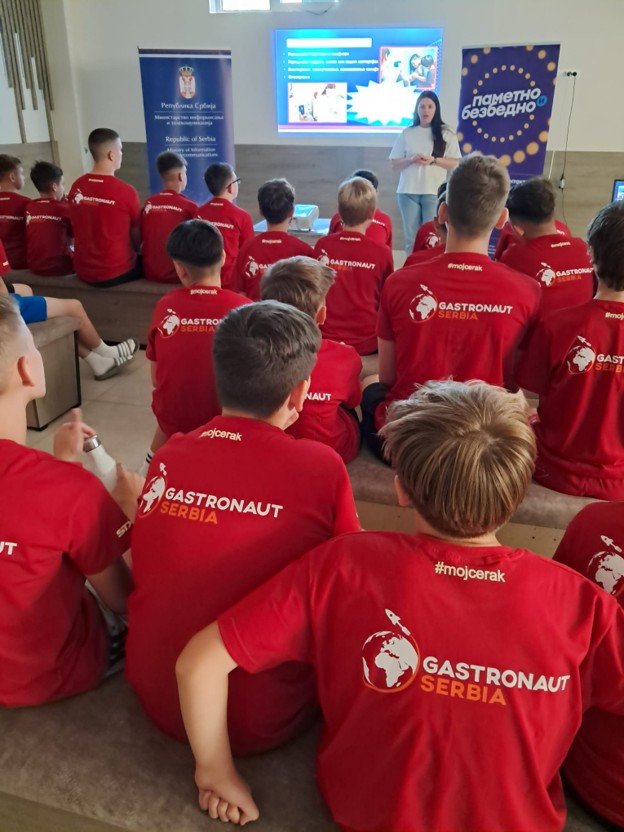
Summer sports camps have proven to be particularly valuable settings for this type of education, as they bring together large numbers of children and young people from different communities and backgrounds. Thanks to the cooperation of SIC Serbia with camp organisers and coaches, it was possible to introduce digital safety topics to children outside the formal school environment, and to remind them that the principles of safe and responsible online behaviour apply throughout the entire year.
Although the majority of children attending the camps were from the Republic of Serbia, the lectures and workshops were also attended by children from neighbouring countries in the region, as well as from other countries. In total, 1,601 children and 65 coaches participated in the educational lectures and workshops.
It is important to thank all organisers and coaches who recognised the importance of online safety education and enabled SIC Serbia to conduct educational activities throughout the summer at the following camps:
- Vanja Grbić volleyball camp
- “Ratko Nikolić” handball camp
- “DEKI5” football camp
- “Zlatibor” volleyball camp
- “Play Volley” volleyball camp
- KK Teo4 basketball camp
- “Budućnost 2020” volleyball camp
- “Professor Aleksandar Nikolić” academic basketball camp
One of the most important messages that the National Contact Centre for children’s safety on the internet of the Republic of Serbia conveys to children is that they should never have to deal with an online problem on their own. If any content, message, person or situation online makes them feel uncomfortable, frightened, threatened or hurt, it is important that they speak to a parent, teacher, coach or another trusted adult.
For advice, support and the reporting of online safety concerns, the National Contact Centre for children’s safety on the internet is available through the free helpline 19833 in Serbia.
Children can also contact experts at any time by completing the contact form available on the website or by sending a message through the official social media profiles.
Find more information about the work of the Serbian Safer Internet Centre, including its awareness-raising, helpline, hotline, and youth participation services, or find similar information for other Safer Internet Centres throughout Europe.
More on media literacy/education


The National Contact Centre for children’s safety on the internet was very active with its intensive educational activities across the Republic of Serbia throughout the summer school holidays.
During the summer months, educators delivered lectures and workshops at numerous sports camps, using these opportunities to engage children in discussions about the safe, responsible, and appropriate use of the internet and digital technologies.
Growing up in today’s world means that children are present in the digital environment on a daily basis, which is why online safety education should not be limited to the school year. Social media, online games, communication applications, and various digital platforms remain an integral part of children’s everyday lives during the school holidays too. For this reason, the summer period provides an important opportunity to discuss the risks children may encounter online, and the ways in which they can protect themselves.
During various educational sessions, the staff spoke with children and young athletes about protecting their privacy and personal data, communicating with unknown individuals online, cyberbullying, inappropriate content, dangerous social media challenges, and the responsible sharing of photographs and videos. The team also discussed whom they can turn to and how they should seek help if they encounter an online situation that makes them feel uncomfortable, frightened or unsafe.
It is particularly important that children understand that the internet offers numerous opportunities for learning, communication, creativity and entertainment, but that using it safely requires knowledge, critical thinking and awareness of one’s own security and privacy. The aim of the educational activities is not to make children afraid of the digital world, but rather to empower them to recognise potential risks, make responsible decisions, and know how to respond if they encounter a problem.
Summer sports camps have proven to be particularly valuable settings for this type of education, as they bring together large numbers of children and young people from different communities and backgrounds. Thanks to the cooperation of SIC Serbia with camp organisers and coaches, it was possible to introduce digital safety topics to children outside the formal school environment, and to remind them that the principles of safe and responsible online behaviour apply throughout the entire year.
Although the majority of children attending the camps were from the Republic of Serbia, the lectures and workshops were also attended by children from neighbouring countries in the region, as well as from other countries. In total, 1,601 children and 65 coaches participated in the educational lectures and workshops.
It is important to thank all organisers and coaches who recognised the importance of online safety education and enabled SIC Serbia to conduct educational activities throughout the summer at the following camps:
- Vanja Grbić volleyball camp
- “Ratko Nikolić” handball camp
- “DEKI5” football camp
- “Zlatibor” volleyball camp
- “Play Volley” volleyball camp
- KK Teo4 basketball camp
- “Budućnost 2020” volleyball camp
- “Professor Aleksandar Nikolić” academic basketball camp
One of the most important messages that the National Contact Centre for children’s safety on the internet of the Republic of Serbia conveys to children is that they should never have to deal with an online problem on their own. If any content, message, person or situation online makes them feel uncomfortable, frightened, threatened or hurt, it is important that they speak to a parent, teacher, coach or another trusted adult.
For advice, support and the reporting of online safety concerns, the National Contact Centre for children’s safety on the internet is available through the free helpline 19833 in Serbia.
Children can also contact experts at any time by completing the contact form available on the website or by sending a message through the official social media profiles.
Find more information about the work of the Serbian Safer Internet Centre, including its awareness-raising, helpline, hotline, and youth participation services, or find similar information for other Safer Internet Centres throughout Europe.
- media literacy data privacy online-threats
Related content
- < Previous article
- Next article >
More on media literacy/education
- < Previous
- Next >
More on media literacy/education
Related articles


