
Today, the co-chairs of the special panel on child online safety presented the final report, setting out recommendations to help create a safer digital world for children and young people.

Established by President Ursula von der Leyen following her 2025 State of the Union address, the expert panel brought together specialists in child health, psychology, neuroscience, computer science, child rights and digital literacy, alongside young people from across the EU, to examine how children can be better protected and empowered online.
Their goal was to examine the latest evidence, identify the biggest online risks facing children, and propose practical actions to make the internet safer while ensuring children can continue to benefit from the opportunities the digital world offers.
"For decades, we have made the real world safer for children and we must do the same in the digital world. The positive opportunities that technology offers cannot come at the cost of their safety, health or happiness."
Ursula von der Leyen, President of the European Commission
Six guiding principles
The report is built around six guiding principles that aim to balance children's safety online with their rights to learn, participate and benefit from the digital world.
- Developmental approach. Tailor online protections and guidance to children's age, stage of development and individual needs.
- Equality and diversity. Recognise that children experience online risks differently depending on factors such as age, gender, disability and socioeconomic background.
- Protection of minors. Protect children from harmful content, addictive platform features, online abuse and other digital risks through effective safeguards.
- Accountability of digital service providers. Place primary responsibility on platforms to ensure services are safe by design and age-appropriate for children.
- Empowerment and media education. Equip children, parents, caregivers, teachers and educators with the digital skills and media literacy needed to navigate the online world safely.
- Children's rights and participation. Ensure children's rights remain central to online safety measures and give young people opportunities to help shape the digital environment.
What does the report recommend?
A child-centred approach
The report recognises that children experience the online world differently as they grow. Rather than a one-size-fits-all approach, it recommends age-appropriate protectionsthat reflect children's different stages of development, helping them build digital skills and gradually gain independence online.
Protecting children by design
One of the report's central messages is that online platforms should carry the primary responsibility for child safety.
The panel calls for stronger "safety by design" measures, including reducing addictive platform features, limiting exposure to harmful content, and ensuring services are designed with children's well-being in mind from the outset.
The report also recommends shifting the burden of proof to digital service providers, requiring them to demonstrate that their products are safe for children before they can be accessed by minors.
Age-appropriate access
Among its recommendations, the panel proposes EU-wide access restrictions for social media and similar digital services for children under 13, supported by privacy-preserving age-assurance systems.
It also suggests that Member States could introduce additional precautionary measures for older teenagers where appropriate, while continuing to evaluate their effectiveness over time.
Building digital skills
The report stresses that regulation alone will not be enough.
It calls for greater investment in digital literacy, media education and online safety, helping children and young people understand privacy, identify misinformation, recognise AI-generated content, and develop healthy digital habits.
Parents, caregivers and teachers are recognised as key partners in supporting children throughout their digital journey.
A shared responsibility
The panel concludes that keeping children safe online requires action from everyone. While digital platforms must take primary responsibility for creating safer services, parents, educators, policymakers and young people all have an important role in building healthy digital habits and creating a safer online environment.
Practical guidance for families
Alongside the report, two practical guides were published, designed to help families navigate the digital world safely.
For parents and caregivers
The guide includes practical advice on:
- Building healthy screen habits.
- Choosing age-appropriate apps and games.
- Encouraging open conversations about online experiences.
- Protecting children's privacy.
- Recognising online risks and knowing where to get help.
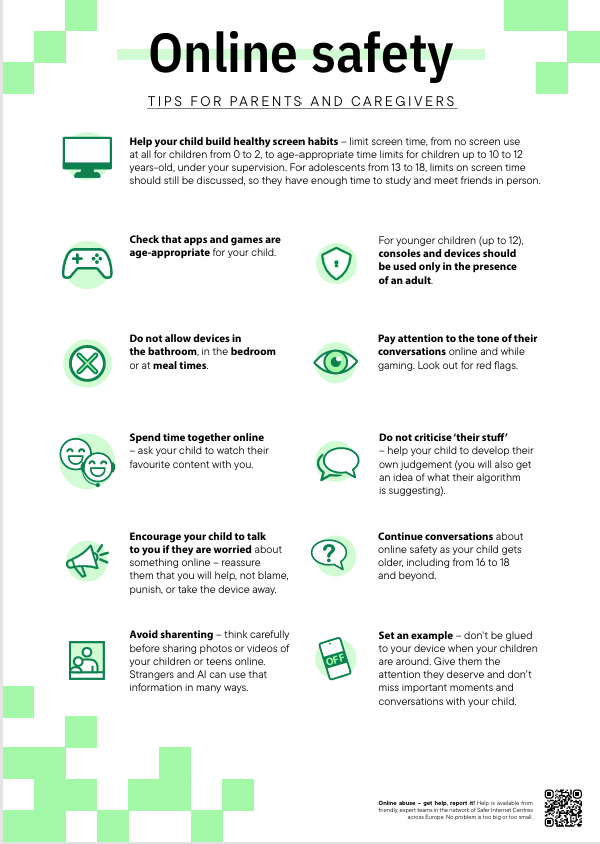
Download the Online safety tips for parents and caregivers guide.
For children and teens
Young people are encouraged to:
- Protect their personal information.
- Think before posting.
- Use privacy and security settings.
- Be cautious of strangers and suspicious messages.
- Report harmful behaviour and ask a trusted adult for help.
- Remember that AI can create false or misleading content.
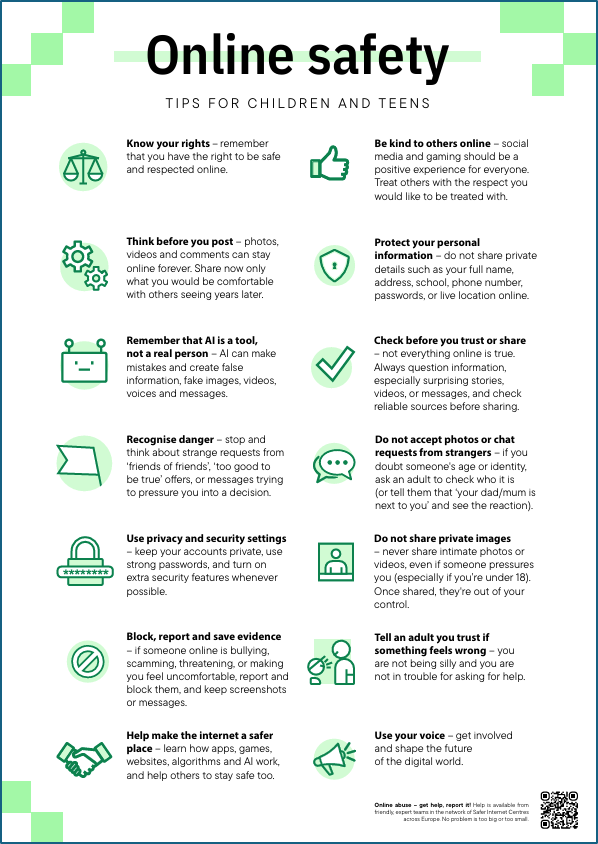
Download the Online safety tips for children and teens guide.
- Access the full report: Child safety online: Protecting and empowering minors in a digital world.
- The summary version is also available in various languages.
- Learn more about the developments of the Special panel on child safety online.
Online abuse – get help, report it! Help is available from friendly, expert teams in the network of Safer Internet Centres across Europe. No problem is too big or too small.


Today, the co-chairs of the special panel on child online safety presented the final report, setting out recommendations to help create a safer digital world for children and young people.
Established by President Ursula von der Leyen following her 2025 State of the Union address, the expert panel brought together specialists in child health, psychology, neuroscience, computer science, child rights and digital literacy, alongside young people from across the EU, to examine how children can be better protected and empowered online.
Their goal was to examine the latest evidence, identify the biggest online risks facing children, and propose practical actions to make the internet safer while ensuring children can continue to benefit from the opportunities the digital world offers.
"For decades, we have made the real world safer for children and we must do the same in the digital world. The positive opportunities that technology offers cannot come at the cost of their safety, health or happiness."
Ursula von der Leyen, President of the European Commission
Six guiding principles
The report is built around six guiding principles that aim to balance children's safety online with their rights to learn, participate and benefit from the digital world.
- Developmental approach. Tailor online protections and guidance to children's age, stage of development and individual needs.
- Equality and diversity. Recognise that children experience online risks differently depending on factors such as age, gender, disability and socioeconomic background.
- Protection of minors. Protect children from harmful content, addictive platform features, online abuse and other digital risks through effective safeguards.
- Accountability of digital service providers. Place primary responsibility on platforms to ensure services are safe by design and age-appropriate for children.
- Empowerment and media education. Equip children, parents, caregivers, teachers and educators with the digital skills and media literacy needed to navigate the online world safely.
- Children's rights and participation. Ensure children's rights remain central to online safety measures and give young people opportunities to help shape the digital environment.
What does the report recommend?
A child-centred approach
The report recognises that children experience the online world differently as they grow. Rather than a one-size-fits-all approach, it recommends age-appropriate protectionsthat reflect children's different stages of development, helping them build digital skills and gradually gain independence online.
Protecting children by design
One of the report's central messages is that online platforms should carry the primary responsibility for child safety.
The panel calls for stronger "safety by design" measures, including reducing addictive platform features, limiting exposure to harmful content, and ensuring services are designed with children's well-being in mind from the outset.
The report also recommends shifting the burden of proof to digital service providers, requiring them to demonstrate that their products are safe for children before they can be accessed by minors.
Age-appropriate access
Among its recommendations, the panel proposes EU-wide access restrictions for social media and similar digital services for children under 13, supported by privacy-preserving age-assurance systems.
It also suggests that Member States could introduce additional precautionary measures for older teenagers where appropriate, while continuing to evaluate their effectiveness over time.
Building digital skills
The report stresses that regulation alone will not be enough.
It calls for greater investment in digital literacy, media education and online safety, helping children and young people understand privacy, identify misinformation, recognise AI-generated content, and develop healthy digital habits.
Parents, caregivers and teachers are recognised as key partners in supporting children throughout their digital journey.
A shared responsibility
The panel concludes that keeping children safe online requires action from everyone. While digital platforms must take primary responsibility for creating safer services, parents, educators, policymakers and young people all have an important role in building healthy digital habits and creating a safer online environment.
Practical guidance for families
Alongside the report, two practical guides were published, designed to help families navigate the digital world safely.
For parents and caregivers
The guide includes practical advice on:
- Building healthy screen habits.
- Choosing age-appropriate apps and games.
- Encouraging open conversations about online experiences.
- Protecting children's privacy.
- Recognising online risks and knowing where to get help.
Download the Online safety tips for parents and caregivers guide.
For children and teens
Young people are encouraged to:
- Protect their personal information.
- Think before posting.
- Use privacy and security settings.
- Be cautious of strangers and suspicious messages.
- Report harmful behaviour and ask a trusted adult for help.
- Remember that AI can create false or misleading content.
Download the Online safety tips for children and teens guide.
- Access the full report: Child safety online: Protecting and empowering minors in a digital world.
- The summary version is also available in various languages.
- Learn more about the developments of the Special panel on child safety online.
Online abuse – get help, report it! Help is available from friendly, expert teams in the network of Safer Internet Centres across Europe. No problem is too big or too small.
- addictive design policy tips parenting tips digital literacy age-appropriate design
Related content
- < Previous article
- Next article >
- < Previous
- Next >
Related articles


