
The Portuguese Safer Internet Centre (SIC) actively participated in the 12th edition of C-DAYS, organised by the National Cybersecurity Centre (CNCS). This leading national event in the field of cybersecurity took place from 16 to 18 June 2026 in Porto, Portugal. Throughout the conference, the SIC organised several awareness talks.

On 16 June, a session entitled "Awareness campaigns: cases and experiences" took place, presenting three cybersecurity awareness campaign case studies and highlighting different strategies, target audiences, and outcomes achieved. The panel featured Carolina Soares (Associação Portuguesa de Apoio à Vítima – APAV), Marisa Lucas (Instituto de Educação, Qualidade e Avaliação – EduQA), and João Pires (Associação Portuguesa de Bancos – APB), and was moderated by Pedro Mendonça (Centro Nacional de Cibersegurança – CNCS). The session aimed to inspire new practices and encourage the exchange of experiences, contributing to the development of more impactful campaigns adapted to the current needs of the digital society.
On the second day, the morning began with a discussion on digital spaces and how they have become central for how we learn about the world and each other, and how we connect. However, alongside their many benefits, these environments are also being used to spread hate, abuse and misogyny, facilitating radicalisation, disinformation, and the normalisation of hostile discourse and behaviours. Under the theme "Between algorithms and identities: young boys in the era of digital bubbles", the panel brought together Bruno Pereira (University of Porto), Ricardo Vieira (Judiciary Police), and Paula Cosme Pinto, with moderation by Patrícia São João (CNCS) to reflect on and share possible courses of action in response to a phenomenon that, despite receiving significant media attention, still lacks direct intervention.
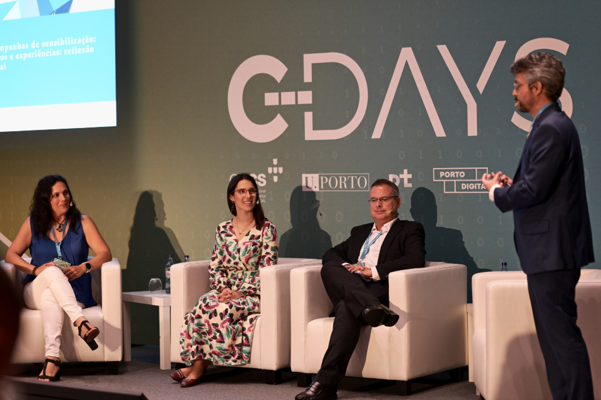
On the final day of C-DAYS, 18 June, discussions and reflections were dedicated to "Digital technologies and mental health", from the perspectives of education, health, and media. The session examined both risks and opportunities, as well as prevention strategies. Moderated by Elsa Caetano (CNCS), this informed and interdisciplinary debate featured the expertise of Vânia Bastos (Instituto Português do Desporto e Juventude – IPDJ), Natália Pestana (PROBRANCA – Associação para o Desenvolvimento Sócio-Cultural da Branca, Coordinator of the Web4Kids project), and Fernanda Bonacho (Escola Superior de Comunicação Social – ESCS, LIACOM/UNESCO Chair in Communication, Media Literacy and Citizenship), identifying strategies that promote more conscious, safe, and healthy uses of digital technologies.
At the end of these three days, the Portuguese Safer Internet Centre successfully responded to the challenge set by this edition of C-DAYS, with the support of several partners who collectively reinforced the importance of awareness raising and digital literacy, while contributing to discussions on some of the most relevant and pressing topics in today's digital world.
Find more information about the work of the Portuguese Safer Internet Centre, including its awareness raising, helpline, hotline, and youth participation services, or find similar information for other Safer Internet Centres throughout Europe.


The Portuguese Safer Internet Centre (SIC) actively participated in the 12th edition of C-DAYS, organised by the National Cybersecurity Centre (CNCS). This leading national event in the field of cybersecurity took place from 16 to 18 June 2026 in Porto, Portugal. Throughout the conference, the SIC organised several awareness talks.
On 16 June, a session entitled "Awareness campaigns: cases and experiences" took place, presenting three cybersecurity awareness campaign case studies and highlighting different strategies, target audiences, and outcomes achieved. The panel featured Carolina Soares (Associação Portuguesa de Apoio à Vítima – APAV), Marisa Lucas (Instituto de Educação, Qualidade e Avaliação – EduQA), and João Pires (Associação Portuguesa de Bancos – APB), and was moderated by Pedro Mendonça (Centro Nacional de Cibersegurança – CNCS). The session aimed to inspire new practices and encourage the exchange of experiences, contributing to the development of more impactful campaigns adapted to the current needs of the digital society.
On the second day, the morning began with a discussion on digital spaces and how they have become central for how we learn about the world and each other, and how we connect. However, alongside their many benefits, these environments are also being used to spread hate, abuse and misogyny, facilitating radicalisation, disinformation, and the normalisation of hostile discourse and behaviours. Under the theme "Between algorithms and identities: young boys in the era of digital bubbles", the panel brought together Bruno Pereira (University of Porto), Ricardo Vieira (Judiciary Police), and Paula Cosme Pinto, with moderation by Patrícia São João (CNCS) to reflect on and share possible courses of action in response to a phenomenon that, despite receiving significant media attention, still lacks direct intervention.
On the final day of C-DAYS, 18 June, discussions and reflections were dedicated to "Digital technologies and mental health", from the perspectives of education, health, and media. The session examined both risks and opportunities, as well as prevention strategies. Moderated by Elsa Caetano (CNCS), this informed and interdisciplinary debate featured the expertise of Vânia Bastos (Instituto Português do Desporto e Juventude – IPDJ), Natália Pestana (PROBRANCA – Associação para o Desenvolvimento Sócio-Cultural da Branca, Coordinator of the Web4Kids project), and Fernanda Bonacho (Escola Superior de Comunicação Social – ESCS, LIACOM/UNESCO Chair in Communication, Media Literacy and Citizenship), identifying strategies that promote more conscious, safe, and healthy uses of digital technologies.
At the end of these three days, the Portuguese Safer Internet Centre successfully responded to the challenge set by this edition of C-DAYS, with the support of several partners who collectively reinforced the importance of awareness raising and digital literacy, while contributing to discussions on some of the most relevant and pressing topics in today's digital world.
Find more information about the work of the Portuguese Safer Internet Centre, including its awareness raising, helpline, hotline, and youth participation services, or find similar information for other Safer Internet Centres throughout Europe.
- cybersecurity digital identity new-technology digital health
Related content
- < Previous article
- Next article >
- < Previous
- Next >
Related articles


