

Here, we take an in-depth look at the latest monitoring information for Ireland.
According to the Digital Decade 2025: Country reports,Ireland’s digital landscape is characterised by its significant economic impact and a strong commitment to a human-centred digital environment. The Information and Communication Technologies (ICT) sector is a primary economic driver, accounting for approximately 17% of the nation's Gross Value Added and 13% of its GDP.
According to the State of the Digital Decade Eurobarometer 2025, 77% of Irish people consider that the digitalisation of daily public and private services is making their lives easier. Regarding actions of public authorities, 92% consider it important to counter and mitigate the issue of fake news and disinformation online. Regarding actions to protect minors online, 98% of adults consider it important to address the negative impact of social media on children’s mental health, while 97% consider cyberbullying and online harassment to be urgent. 97% were also in favour of implementing age-assurance mechanisms to restrict age-inappropriate content. Ireland has enacted proactive policies such as the Online Safety and Media Regulation Act (OSMR), which established Coimisiún na Meán as an independent regulator.
Read the full 2026 edition of the Policy monitor report.
BIK policies
This concerns how national-level policies relevant to the BIK agenda are organised, managed, and supported by evidence and stakeholder input.
Policy frameworks
Policy frameworks describe the overarching goals that shape policies for a better internet for kids.
In Ireland:
This topic is being comprehensively addressed with children’s protection, empowerment and participation in the digital environment incorporated into national/regional laws, regulations and policies.
There are separate, dedicated policies which address the topic of children and the digital environment (protection, empowerment, and participation).
The BIK+ strategy is an important influence on policy development on children and the digital environment.
National/regional policies and policy documents explicitly recognise children's rights in the digital environment.
Policy design
Policy design asks whether evidence and research support BIK-related policies and whether systems are in place for monitoring and evaluating those policies.
In Ireland:
- Surveys of children’s digital activities are undertaken, but only irregularly
- Some but not all aspects of children’s experiences of risks, harms and digital well-being are included in regular surveys
- Systems are in place at the government level to gather information on children and the digital environment
- Existing regular national research funding is available for research on children and the digital environment
- Policies are regularly monitored and evaluated, but not always systematically.
Policy governance
Policy governance examines how policies are coordinated at the governmental level, whether other implementation bodies are involved in their delivery and coordination.
In Ireland:
- One central body (e.g., the central ministry office, public agency, or regulatory authority) is officially mandated to lead and develop policies, guidelines, and programmes.
- A clearly defined, formal coordination mechanism exists with a clear mandate engaging relevant stakeholders and coherent, cross-cutting policy development and implementation.
- There is a defined national action plan on children and the digital environment.
Stakeholder involvement
Stakeholder involvement enquires how different stakeholders can participate in policy development.
- Various groups exist across different branches of government, in which stakeholders may contribute to policy discussion and development.
- Members of the public are regularly and routinely consulted as part of the policy development process.
- Children are actively involved in the design of policies related to their participation in the digital environment. There are specially designed structures in place for this purpose.
Read the full 2026 edition of the Policy monitor report.
BIK+ actions
Pillar 1 – safe digital experiences
Safe digital experiences refer to actions taken to protect children from harmful and illegal online content, conduct, contact, and risks as young consumers and to improve their well-being online through a safe, age-appropriate digital environment created in a way that respects children’s best interests.
| In place | In development | Other activity | Not present | |
|---|---|---|---|---|
| Content rating systems for online/video games | X | |||
| DSC measures: protection of minors | X | |||
| DSC-SIC working relationship | X | |||
| Definition of harmful online content | X | |||
| Complaints handling mechanism | X | |||
| Intimate image abuse laws | X | |||
| Cyberbullying laws | X | |||
| Age verification requirements | X | |||
| Digital wallet for minors | X | |||
| EU harmonised age verification |
| X |
| |
| Laws on online marketing |
| X | ||
| Protecting mental health and well-being | X |
|
Pillar 2 – digital empowerment
Digital empowerment involves actions that ensure all children, including those in vulnerable situations, acquire the necessary skills and competences to make sound choices and to express themselves safely and responsibly in the online environment.
| In place | In development | Other activity | Not present | |
|---|---|---|---|---|
| Teaching online safety | X | |||
| Digital skills training | X | |||
| Policies on digital use in schools | X | |||
| Adequate teacher training | X | |||
| Non-formal online safety education | X | |||
| Critical media literacy | X | |||
| Creative digital skills | X | |||
| Supports for parents | X |
Pillar 3 – active participation, respecting children’s rights
This includes actions that promote young people's active participation and respect for their rights through such activities as fostering innovative and creative safe digital experiences for young people and ensuring they have a say in policies governing the digital environment.
| In place | In development | Other activity | Not present | |
|---|---|---|---|---|
| Promoting civic engagement | X | |||
| Promoting children’s rights | X | |||
| Child-friendly policy documents | X | |||
| Addressing digital inequalities | X | |||
| Positive digital content | X |
Read the full 2026 edition of the Policy monitor report.
BIK+ index 2026: Ireland
The BIK+ index has been developed to provide an aggregated at-a-glance overview of the levels of implementation across the two dimensions, BIK policies and BIK+ actions, in Ireland compared to the EU27+2 average. Values are shown in per cent.
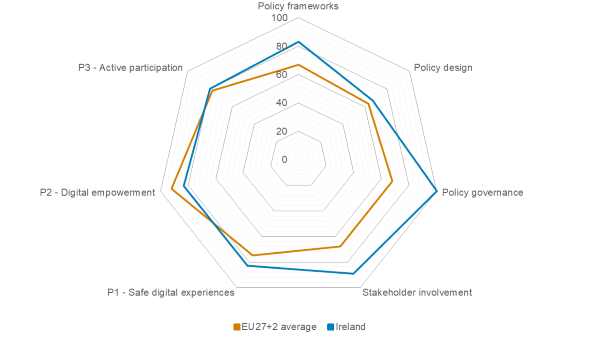
Please note, the data used in this page and the corresponding country profile was collected in January 2026.
National research and reports


Here, we take an in-depth look at the latest monitoring information for Ireland.
According to the Digital Decade 2025: Country reports,Ireland’s digital landscape is characterised by its significant economic impact and a strong commitment to a human-centred digital environment. The Information and Communication Technologies (ICT) sector is a primary economic driver, accounting for approximately 17% of the nation's Gross Value Added and 13% of its GDP.
According to the State of the Digital Decade Eurobarometer 2025, 77% of Irish people consider that the digitalisation of daily public and private services is making their lives easier. Regarding actions of public authorities, 92% consider it important to counter and mitigate the issue of fake news and disinformation online. Regarding actions to protect minors online, 98% of adults consider it important to address the negative impact of social media on children’s mental health, while 97% consider cyberbullying and online harassment to be urgent. 97% were also in favour of implementing age-assurance mechanisms to restrict age-inappropriate content. Ireland has enacted proactive policies such as the Online Safety and Media Regulation Act (OSMR), which established Coimisiún na Meán as an independent regulator.
Read the full 2026 edition of the Policy monitor report.
BIK policies
This concerns how national-level policies relevant to the BIK agenda are organised, managed, and supported by evidence and stakeholder input.
Policy frameworks
Policy frameworks describe the overarching goals that shape policies for a better internet for kids.
In Ireland:
This topic is being comprehensively addressed with children’s protection, empowerment and participation in the digital environment incorporated into national/regional laws, regulations and policies.
There are separate, dedicated policies which address the topic of children and the digital environment (protection, empowerment, and participation).
The BIK+ strategy is an important influence on policy development on children and the digital environment.
National/regional policies and policy documents explicitly recognise children's rights in the digital environment.
Policy design
Policy design asks whether evidence and research support BIK-related policies and whether systems are in place for monitoring and evaluating those policies.
In Ireland:
- Surveys of children’s digital activities are undertaken, but only irregularly
- Some but not all aspects of children’s experiences of risks, harms and digital well-being are included in regular surveys
- Systems are in place at the government level to gather information on children and the digital environment
- Existing regular national research funding is available for research on children and the digital environment
- Policies are regularly monitored and evaluated, but not always systematically.
Policy governance
Policy governance examines how policies are coordinated at the governmental level, whether other implementation bodies are involved in their delivery and coordination.
In Ireland:
- One central body (e.g., the central ministry office, public agency, or regulatory authority) is officially mandated to lead and develop policies, guidelines, and programmes.
- A clearly defined, formal coordination mechanism exists with a clear mandate engaging relevant stakeholders and coherent, cross-cutting policy development and implementation.
- There is a defined national action plan on children and the digital environment.
Stakeholder involvement
Stakeholder involvement enquires how different stakeholders can participate in policy development.
- Various groups exist across different branches of government, in which stakeholders may contribute to policy discussion and development.
- Members of the public are regularly and routinely consulted as part of the policy development process.
- Children are actively involved in the design of policies related to their participation in the digital environment. There are specially designed structures in place for this purpose.
Read the full 2026 edition of the Policy monitor report.
BIK+ actions
Pillar 1 – safe digital experiences
Safe digital experiences refer to actions taken to protect children from harmful and illegal online content, conduct, contact, and risks as young consumers and to improve their well-being online through a safe, age-appropriate digital environment created in a way that respects children’s best interests.
| In place | In development | Other activity | Not present | |
|---|---|---|---|---|
| Content rating systems for online/video games | X | |||
| DSC measures: protection of minors | X | |||
| DSC-SIC working relationship | X | |||
| Definition of harmful online content | X | |||
| Complaints handling mechanism | X | |||
| Intimate image abuse laws | X | |||
| Cyberbullying laws | X | |||
| Age verification requirements | X | |||
| Digital wallet for minors | X | |||
| EU harmonised age verification |
| X |
| |
| Laws on online marketing |
| X | ||
| Protecting mental health and well-being | X |
|
Pillar 2 – digital empowerment
Digital empowerment involves actions that ensure all children, including those in vulnerable situations, acquire the necessary skills and competences to make sound choices and to express themselves safely and responsibly in the online environment.
| In place | In development | Other activity | Not present | |
|---|---|---|---|---|
| Teaching online safety | X | |||
| Digital skills training | X | |||
| Policies on digital use in schools | X | |||
| Adequate teacher training | X | |||
| Non-formal online safety education | X | |||
| Critical media literacy | X | |||
| Creative digital skills | X | |||
| Supports for parents | X |
Pillar 3 – active participation, respecting children’s rights
This includes actions that promote young people's active participation and respect for their rights through such activities as fostering innovative and creative safe digital experiences for young people and ensuring they have a say in policies governing the digital environment.
| In place | In development | Other activity | Not present | |
|---|---|---|---|---|
| Promoting civic engagement | X | |||
| Promoting children’s rights | X | |||
| Child-friendly policy documents | X | |||
| Addressing digital inequalities | X | |||
| Positive digital content | X |
Read the full 2026 edition of the Policy monitor report.
BIK+ index 2026: Ireland
The BIK+ index has been developed to provide an aggregated at-a-glance overview of the levels of implementation across the two dimensions, BIK policies and BIK+ actions, in Ireland compared to the EU27+2 average. Values are shown in per cent.
Please note, the data used in this page and the corresponding country profile was collected in January 2026.
National research and reports

